The Problem with Static Network Documentation
Traditional network documentation often suffers from the same limitations:
Documentation is manual and time-consuming
Network diagrams quickly become outdated
VLAN propagation is difficult to visualize
Troubleshooting requires checking devices one by one When investigating problems such as:
VLANs not propagating across switches
Misconfigured trunk links
Missing inter-switch connections
Layer 2 topology issues engineers often realize that the documentation no longer reflects the real network. This lack of network visibility slows down troubleshooting and increases operational risk.
Why Dynamic Network Topology is Essential
A dynamic network topology automatically reflects the real state of the infrastructure. Instead of relying on static diagrams, network engineers can instantly visualize:
How switches are interconnected
Which VLANs are propagated across the network
Where segmentation occurs
Which devices are part of the infrastructure This creates real-time network visibility across the entire environment.
Faster Network Troubleshooting
One of the biggest benefits of dynamic topology is faster troubleshooting. Engineers can immediately identify issues such as:
VLANs not being propagated across trunk links
Incorrect switch uplinks
Missing inter-switch connections
Unexpected topology changes Instead of manually checking configuration on multiple devices, teams can identify the problem directly in the topology.
Dynamic Topology as Living Network Documentation
Dynamic topology also solves one of the biggest challenges in enterprise IT: Keeping network documentation accurate. Instead of manually updating diagrams, documentation becomes:
Automatically updated
Always aligned with the real infrastructure
Available to operations, network engineers and architects This creates a living network documentation that provides visibility into:
All network devices
Interconnections between switches and routers
VLAN segmentation across the infrastructure The topology becomes the single source of truth for the network.
ConnectMyAssets: Real-Time Dynamic Network Topology
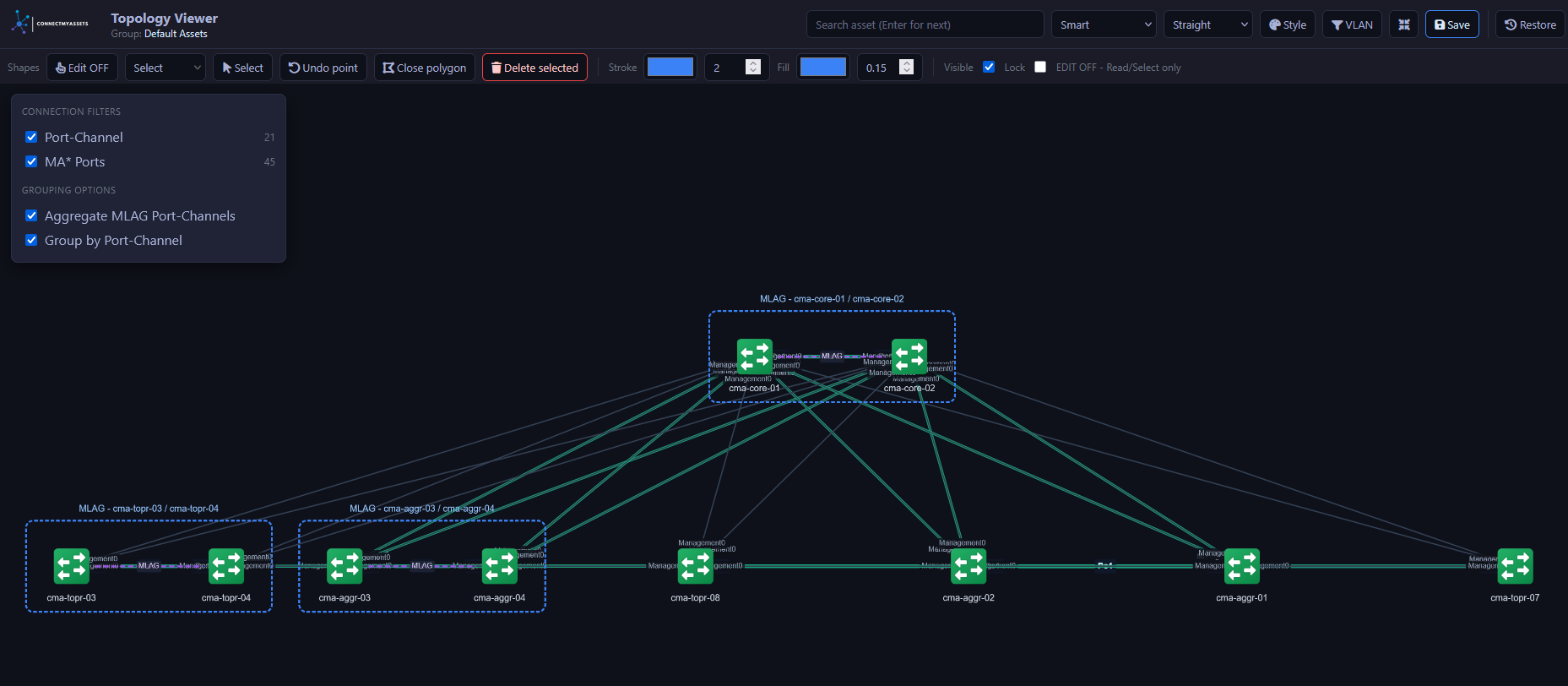
With ConnectMyAssets, organizations can automatically generate a fully dynamic topology of their entire network. The platform continuously discovers infrastructure devices and builds a real-time visual map of the network. This provides instant network visibility without manual documentation.
Real-Time Network Topology Mapping
ConnectMyAssets automatically maps:
Switches
Routers
Firewalls
Inter-switch connections The topology dynamically reflects the real state of the network, eliminating outdated diagrams. Network engineers can instantly understand how devices are interconnected across the infrastructure.
Real-Time VLAN Visibility
One of the most powerful capabilities of ConnectMyAssets is the ability to visualize VLAN propagation directly on the topology. Teams can immediately see:
Which VLANs are present on each device
How VLANs propagate across trunk links
Where VLAN diffusion stops This makes it much easier to troubleshoot:
VLAN propagation issues
Incorrect trunk configurations
Network segmentation problems
Fully Customizable Network Topology
Every network team has its own way of visualizing infrastructure. With ConnectMyAssets, the topology is fully customizable, allowing engineers to:
Organize devices according to their architecture
Focus on specific parts of the infrastructure
Customize the topology layout to match operational needs This flexibility allows teams to create a topology that truly reflects how they manage their network.
From Static Diagrams to Real-Time Network Visibility
Modern enterprise networks require modern tools. A dynamic network topology provides:
Faster troubleshooting
Accurate and up-to-date network documentation
Clear visibility into the entire infrastructure With ConnectMyAssets, organizations can move beyond static diagrams and gain real-time insight into their network architecture. And in complex enterprise environments, that visibility makes all the difference.