Netmiko Becomes a Bigger Part of netlab
Device configuration through Netmiko first appeared in the September 2026 netlab release. The October release made that option easier to use, setting the stage for a broader change.
According to ipSpace.net, Netmiko is expected to become the default configuration method for several widely used platforms within a few months:
Arista EOS
Cisco IOS
Cisco Nexus OS
Cisco IOS XR
FRRouting virtual machines
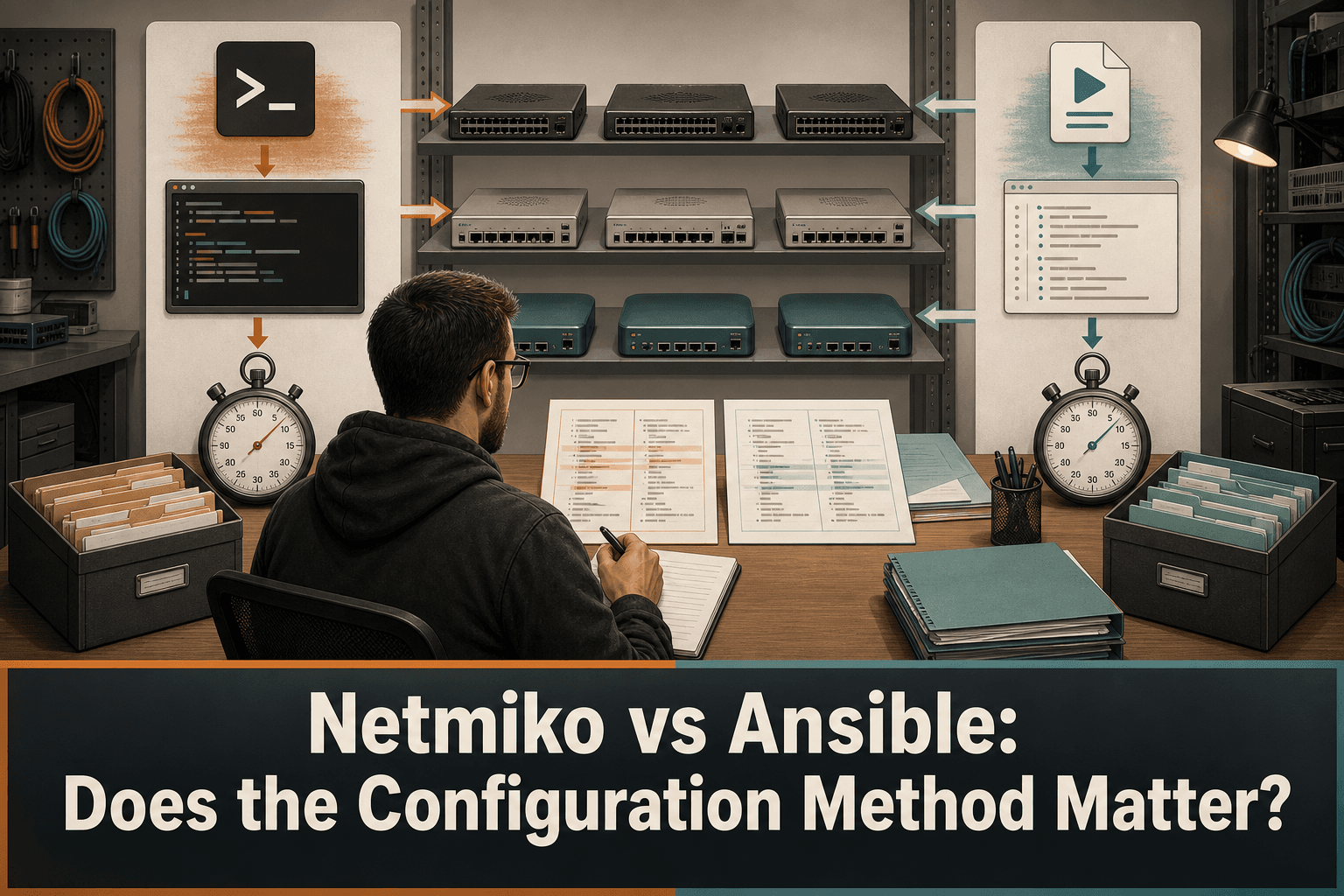
Before making that switch, the author compared Netmiko and Ansible to determine whether the configuration method materially affects the outcome. The short conclusion is unambiguous: yes, it does.
The published summary does not provide benchmark figures, platform-by-platform results, or detailed test parameters. Those details should therefore be taken from the full source rather than inferred.
What Infrastructure Teams Should Compare
Performance is important when the same configuration must be applied repeatedly across many devices. However, execution time should not be the only selection criterion for a production workflow.
A useful evaluation should consider three areas.
1. Repeatability
The same input should produce a predictable result across supported devices. Teams should test the complete workflow rather than assume that a successful run on one platform represents every target.
Because the planned netlab change spans EOS, IOS, Nexus OS, IOS XR, and FRRouting virtual machines, multi-platform validation is especially relevant.
2. Performance
The source specifically asks whether changing from Ansible to Netmiko matters and concludes that it does. For an internal assessment, teams should preserve the conditions behind each run so that comparisons remain meaningful.
Useful questions include:
Were the same devices and configurations used?
Was the test repeated under comparable conditions?
Was the full workflow measured, rather than only one execution step?
Did every run complete successfully?
These questions do not replace the source benchmark; they help turn a performance observation into a repeatable engineering decision.
3. Automation Evidence
A fast configuration run is not automatically an auditable one. Production automation also needs evidence of what changed, when it changed, and whether the resulting state still complies with policy.
The strongest automation workflow combines repeatable execution with configuration history and verifiable results.
Before adopting a new default method, keep the original configuration, the resulting configuration, execution records, and validation outcome together. That evidence becomes important during troubleshooting, rollback, compliance reviews, and incident analysis.
A Practical Evaluation Process
Teams considering a similar change can use a controlled process:
Define an identical configuration task for every method under review.
Select representative devices from each supported platform.
Capture the configuration before execution.
Run each method under comparable conditions.
Record completion status and performance observations.
Capture and compare the resulting configuration.
Validate the final state against operational and compliance requirements.
Retain the evidence so the decision can be reviewed later.
This separates a convenient automation choice from a defensible infrastructure standard.
How ConnectMyAssets Helps
ConnectMyAssets provides an on-prem, vendor-agnostic management layer around multi-vendor infrastructure. It does not require teams to treat execution speed as the only measure of automation quality.
Relevant modules include:
Automation & ZTP for repeatable infrastructure workflows.
Backup & History for configuration versioning and one-click rollback.
Compliance Engine for checking infrastructure against NIS2, ISO 27001, PCI, CISA, and NIST requirements.
Dynamic CMDB for maintaining an up-to-date asset record across vendors.
Credential Vault for centrally protecting the credentials used to access managed assets.
Regardless of whether an engineering team evaluates Netmiko, Ansible, or another execution method, ConnectMyAssets helps preserve the surrounding operational evidence: asset context, configuration history, compliance status, and rollback points. That makes a performance-driven change easier to validate and safer to operate.
Source: ipSpace.net