DNS Is More Than Name Resolution
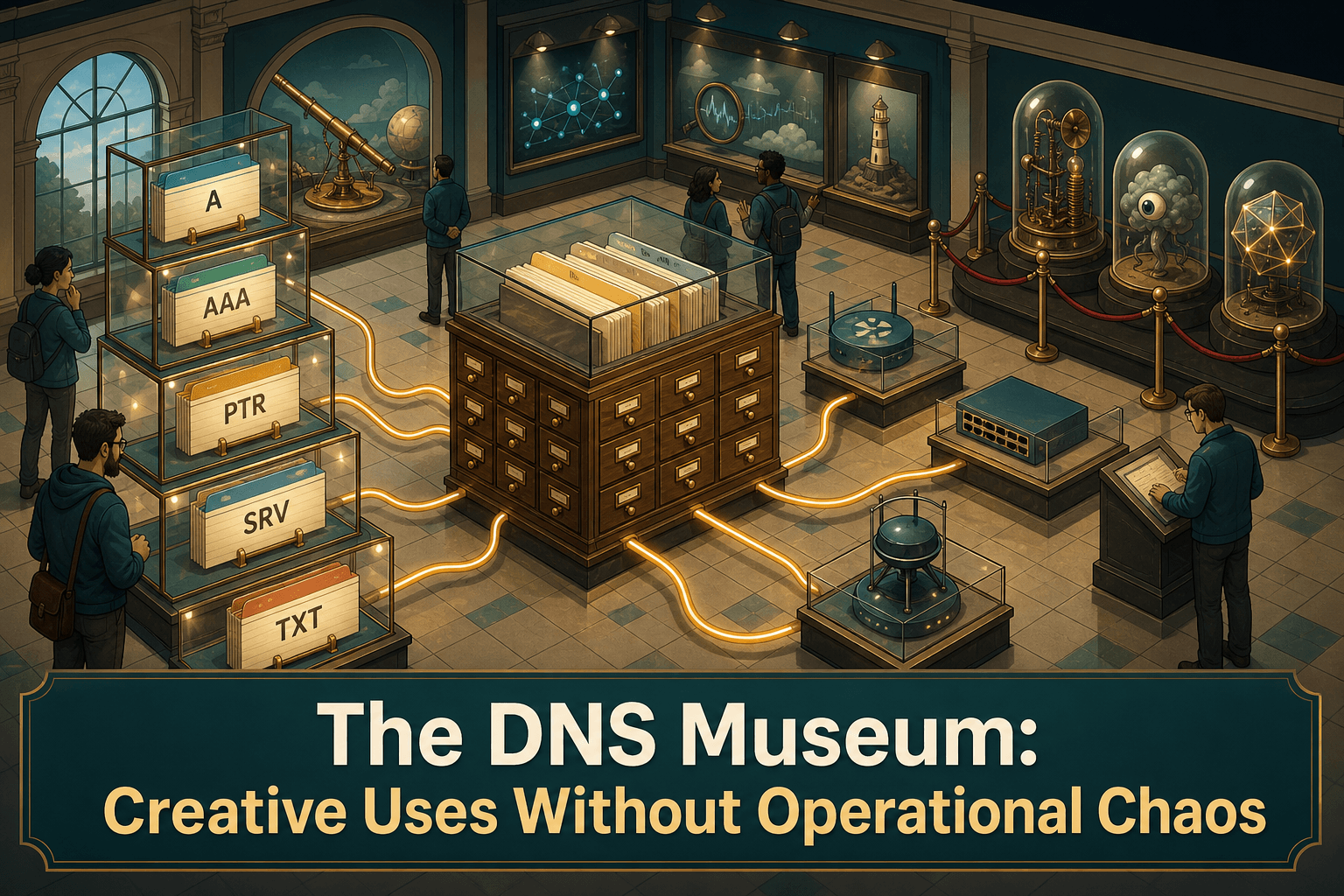
The DNS Museum documents an extensive collection of unconventional DNS uses. The source also highlights a podcast episode with Corey Quinn about using DNS for configuration management.
That premise is appealing because DNS already offers a distributed way to associate names with values. It invites experimentation—but an entertaining prototype can become an opaque production dependency if ownership, scope, and failure behavior are not defined.
The useful question is not simply, “Can we put this in DNS?” It is, “Will the next network team understand, observe, and safely change it?”
Three Operational Patterns Worth Exploring
1. Discovery Through Established Record Types
DNS can help systems and operators locate infrastructure without hard-coding every address. Practical patterns include:
A and AAAA records for resolving stable names to addresses.
PTR records as operational hints during troubleshooting and inventory review.
SRV records for publishing the location of a defined service.
Consistent naming conventions that expose a device’s role, site, or environment without turning every hostname into an unreadable sentence.
Discovery data should have a clear owner and lifecycle. A record that outlives the device or service it describes creates ambiguity rather than useful abstraction.
2. DNS as a Configuration Pointer
Using DNS for configuration does not have to mean storing an entire device configuration in a TXT record. A more maintainable pattern is to publish a small bootstrap value or a pointer to an authoritative configuration source.
For example, a DNS value might indicate:
Which deployment environment a system belongs to.
Which approved service endpoint it should contact.
Which configuration profile or automation workflow should apply.
Whether a temporary operational feature is enabled for a defined scope.
Keep such values small, non-secret, documented, and easy to validate. DNS should not become an improvised credential vault or an undocumented policy engine.
3. DNS as an Observability Surface
DNS lookups can also act as lightweight operational signals. Network teams can run synthetic queries from selected locations and compare:
Whether the query succeeds.
Which answer is returned.
How long resolution takes.
Whether expected records are visible from the intended network segment.
Whether a recent change has reached the places where it is needed.
This can reveal a user-visible symptom before the underlying cause is known. However, DNS caching and record lifetimes must be considered when interpreting results: an old answer does not automatically prove that the authoritative data is still wrong.
Guardrails for Maintainable DNS Experiments
Creative DNS uses should follow the same engineering discipline as any other production dependency:
Define the authority. Document which system creates each record and which team approves changes.
Separate data classes. Do not mix discovery, configuration, and human documentation without a clear schema.
Design for absence. Decide what clients do when a record is missing, stale, malformed, or unreachable.
Avoid secrets. Treat DNS values as discoverable operational data, not protected credentials.
Control naming and scope. Use dedicated zones or namespaces where appropriate so experimental records do not become indistinguishable from core name resolution.
Monitor both answers and behavior. A record can exist while the dependent service is still unavailable.
Plan removal. Every temporary record, feature flag, or migration aid needs an owner and retirement condition.
Where ConnectMyAssets Fits
DNS-based ideas do not replace disciplined infrastructure management. ConnectMyAssets provides an on-prem, vendor-agnostic control layer around the network assets that create, consume, or depend on those records:
The Dynamic CMDB maintains an inventory of multi-vendor assets, helping teams compare DNS naming with the infrastructure that actually exists.
Backup & History versions device configurations and supports one-click rollback when a DNS-related network change has unintended effects.
The Compliance Engine can assess device configurations against internal policy and frameworks including NIS2, ISO 27001, PCI, CISA, and NIST.
Automation & ZTP supports controlled, repeatable deployment instead of relying on undocumented manual changes.
Topology gives teams context about the devices and dependencies affected by a discovery or configuration design.
The Credential Vault keeps administrative credentials in the appropriate protected system rather than embedding secrets in DNS values.
The result is a useful separation of concerns: DNS can provide a creative distributed lookup mechanism, while ConnectMyAssets manages the inventory, configuration history, compliance, credentials, and automation surrounding the underlying network infrastructure.
Experiment, but Leave a Map
The DNS Museum is a reminder that mature protocols often have more creative potential than their everyday use suggests. Network teams should explore that potential—but production adoption should require clear semantics, ownership, monitoring, and an exit plan.
The best DNS trick is not merely clever. It is one that another engineer can discover, understand, test, and safely retire.
Source: ipSpace.net