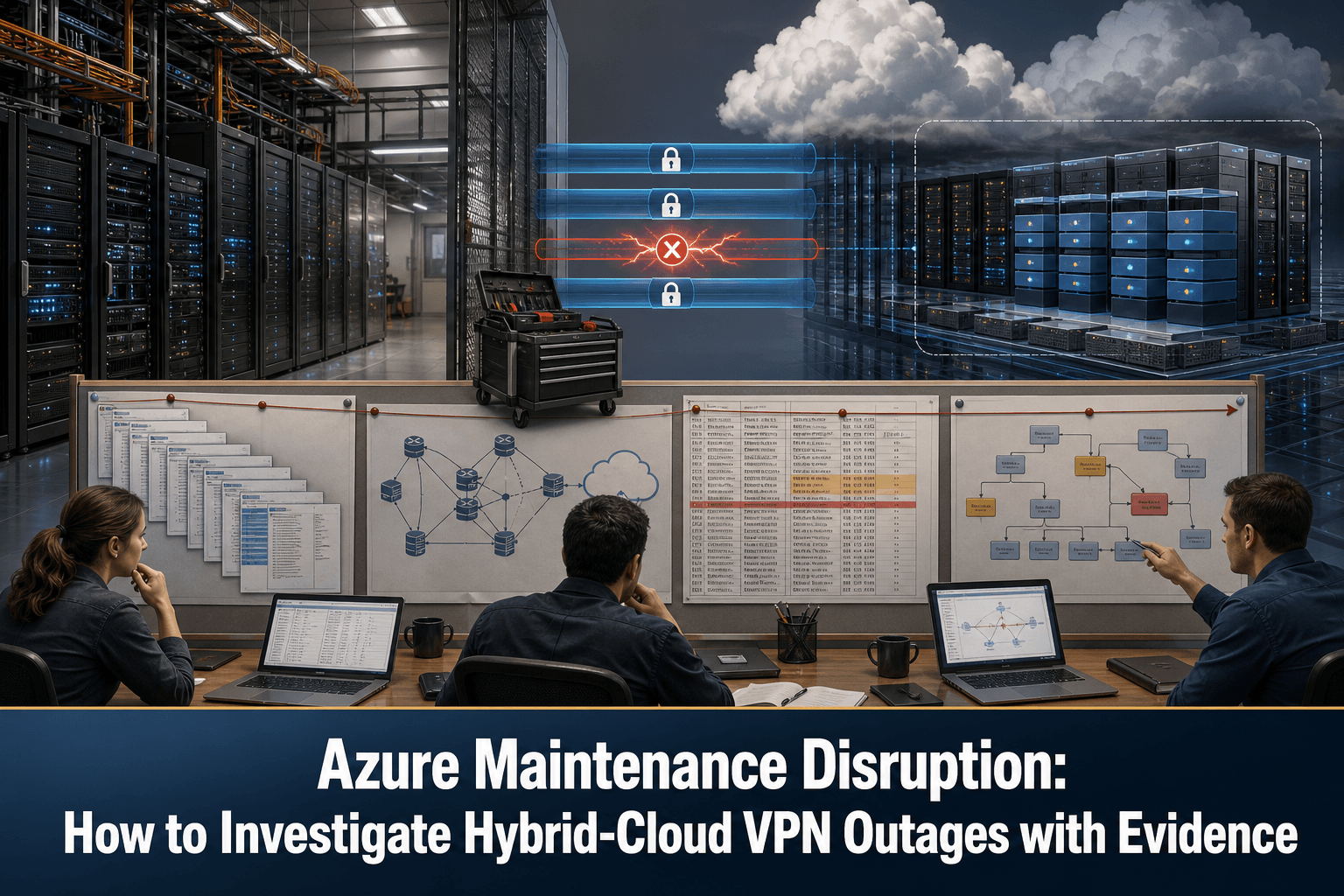
Maintenance Can Be the Trigger Without Being the Full Explanation
According to The Register, an Azure maintenance event disrupted hybrid clouds, VPN connectivity, and VMware-based cloud services. The report’s central complication is equally important: Microsoft had not established exactly how its own maintenance produced the wider disruption.
That uncertainty is familiar to infrastructure teams. A maintenance window may provide the first timestamp in an incident timeline, but it does not automatically explain every symptom. Hybrid connectivity depends on components operated by different teams and vendors, including VPN gateways, routing policies, firewalls, virtual infrastructure, and the applications using those paths.
A credible outage report distinguishes what happened, when it happened, and what evidence links one event to another.
Why Hybrid-Cloud Failures Are Difficult to Reconstruct
A user may experience one outage while the network team sees several separate technical events. A VPN can appear unavailable because the tunnel itself failed, because routes stopped reaching it, or because a dependent service became unreachable beyond the tunnel.
The challenge is therefore not merely to confirm that connectivity was lost. Investigators need to determine:
Which sites, gateways, services, and network paths were affected.
Whether all symptoms began at the same time.
What changed immediately before the first verified failure.
Whether device configurations changed during the incident.
Which dependencies remained healthy and which did not.
When service recovery occurred for each affected path.
The reported Azure incident is a reminder not to collapse these questions into a single assumption such as “cloud maintenance caused the VPN outage.” That may be the working hypothesis, but it still needs an evidence chain.
Build an Evidence-Based Incident Timeline
1. Establish a shared time reference
Normalize timestamps before comparing observations from cloud services, VPN peers, firewalls, routers, hypervisors, and monitoring tools. Record the original time zone as well as the normalized value. Otherwise, events that are minutes apart can be mistaken for simultaneous failures.
Start with a small number of defensible milestones:
Last confirmed healthy state.
First confirmed failure.
First configuration or state change near the failure.
Partial recovery, if any.
Full recovery as observed from each side of the connection.
2. Separate observations from interpretations
An observation should describe verifiable evidence: a tunnel changed state, a route disappeared, a configuration checksum changed, or a service probe failed. An interpretation explains what the team believes that evidence means.
Keeping the two separate prevents early theories from becoming accepted facts. It also makes the final analysis easier to revise if the provider later publishes additional findings.
3. Preserve configuration state
For every relevant router, firewall, VPN appliance, and switch, retain the configuration from before, during, and after the event when available. Compare those versions rather than relying on memory or a manually maintained diagram.
Useful questions include:
Did a local configuration change coincide with the provider maintenance?
Were VPN, routing, or firewall parameters altered?
Was an emergency workaround applied and later removed?
Did recovery occur without any local configuration change?
A finding that nothing changed locally is still valuable evidence. It narrows the investigation, provided the configuration history is complete and timestamped.
4. Map the dependency chain
Document the route from the affected workload to its destination. Include the local network, firewall policy, VPN endpoint, cloud-side connection, virtualized service, and any intermediate dependency known to the team.
Do not assume that all applications use the same path simply because they share a cloud provider. Different workloads may depend on different tunnels, routing policies, or virtual environments, producing uneven symptoms and recovery times.
5. Test competing explanations
A sound review considers more than one hypothesis. For example:
The maintenance directly changed a cloud-side network component.
The maintenance exposed a pre-existing dependency or fragile failover path.
A separate local change overlapped with the maintenance window.
Connectivity recovered before all dependent services became usable.
These are investigative possibilities, not claims about the Azure event. Each should be retained or rejected only as evidence permits.
What to Collect Before the Next Incident
Evidence quality depends on preparation. During normal operations, infrastructure teams should maintain:
Versioned device configurations with reliable timestamps.
An inventory linking assets to owners, sites, roles, and dependencies.
Current topology information for critical hybrid paths.
Records of approved and emergency changes.
VPN, routing, firewall, and service-health observations from both ends.
A clear record of temporary remediation and rollback actions.
Provider status information is important, but it should be correlated with evidence from the organization’s own network. A provider’s incident window may not match the exact time at which each customer path failed or recovered.
How ConnectMyAssets Helps
ConnectMyAssets provides an on-premises, vendor-agnostic foundation for preserving and correlating evidence from multi-vendor network infrastructure.
Dynamic CMDB records network assets and their operational context, helping teams identify which devices and services belong to an affected hybrid path.
Backup & History retains configuration versions so investigators can compare device state before and after an outage and use one-click rollback when an approved restoration is required.
Topology helps visualize network relationships and trace dependencies across routers, firewalls, VPN infrastructure, and connected environments.
Firewall Management supports review of the policies governing affected traffic paths.
Automation can apply validated remediation consistently across supported infrastructure, reducing ad hoc changes during a high-pressure incident.
Compliance Engine helps retain disciplined configuration and change practices aligned with frameworks such as NIS2, ISO 27001, PCI, CISA, and NIST.
ConnectMyAssets does not replace cloud-provider incident data. It strengthens the customer-controlled side of the evidence chain: what assets existed, how they were connected, what their configurations contained, and what changed over time.
From Postmortem to Preventive Action
The most useful outcome is not a confident story assembled too early. It is a defensible account that identifies confirmed facts, unresolved questions, and practical improvements.
After a hybrid-cloud outage, teams should convert findings into concrete actions:
Correct undocumented dependencies.
Update topology and asset ownership records.
Test failover paths rather than assuming they work.
Remove temporary configuration changes.
Preserve the final evidence package for future comparison.
Track unresolved provider questions without treating assumptions as root cause.
The Azure maintenance episode illustrates a basic operational truth: complex outages do not always yield an immediate explanation. Reliable configuration history, topology, and disciplined timelines allow network teams to make progress even while the provider’s own root-cause analysis remains incomplete.
Source: The Register