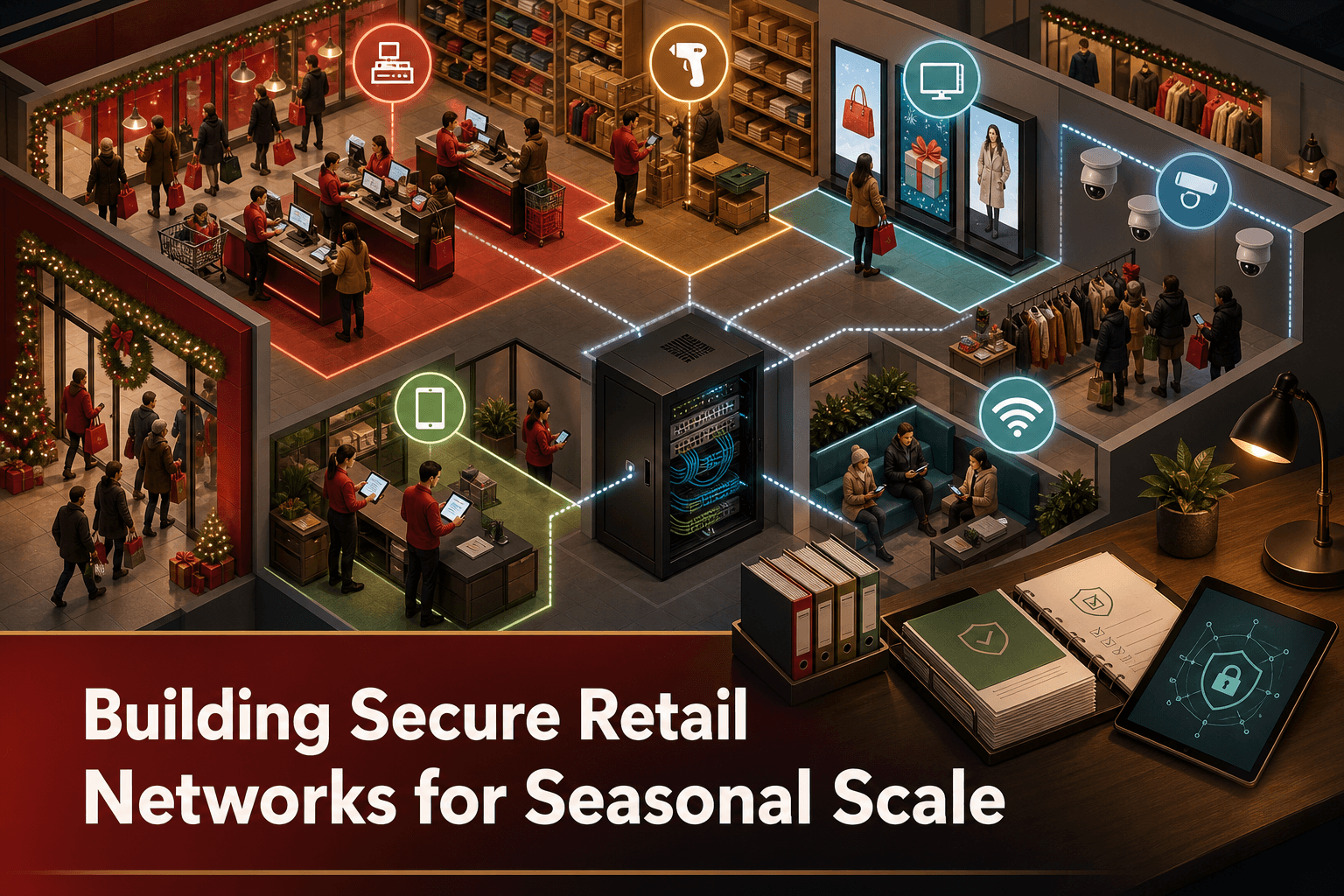
Retail infrastructure has to reconcile three objectives that can easily pull in different directions: security, operational simplicity, and scale. Cisco’s article frames these priorities around distributed stores, seasonal traffic, and the continued arrival of new in-store technology.
For infrastructure teams, the challenge is to turn those broad objectives into branch standards that can be deployed, verified, and maintained across every location.
Simplicity Does Not Mean a Flat Network
A simple retail network should be easy to understand and operate—not one in which every device shares the same level of access.
Stores may connect checkout systems, employee devices, inventory equipment, security systems, guest services, and emerging in-store technologies. Dividing these functions into deliberate segments helps teams apply different access and change policies without treating every endpoint identically.
A practical branch standard should define:
Which device or service groups require separate network segments.
Which connections are permitted between those segments.
Which configuration elements must remain consistent across stores.
Which local variations are acceptable and who can approve them.
What evidence must be retained after a change.
This approach keeps the design understandable while limiting unnecessary connectivity.
Prepare for Seasonal Demand Before It Arrives
Seasonal scale is not only a bandwidth question. Higher transaction volumes, more customer devices, temporary equipment, and operational changes can all increase pressure on a store network.
Before a peak period, network teams can use a repeatable readiness process:
Inventory each branch. Confirm which network assets and in-store systems are present.
Compare configurations with the approved baseline. Identify drift before traffic rises.
Review segmentation and access rules. Check that temporary or newly introduced technology has not gained broader access than intended.
Preserve a known-good configuration. Make recovery easier if a peak-period change causes disruption.
Control emergency changes. Record what changed, where, by whom, and why.
Review the estate after the season. Remove temporary access and document the resulting configuration state.
The objective is not to predict every demand spike. It is to make the branch estate consistent enough that teams can identify and correct exceptions quickly.
Configuration Evidence Is Part of Retail Security
A policy has limited operational value if the organization cannot show whether stores follow it. Distributed environments therefore need evidence at both the individual-device and estate levels.
Useful evidence includes:
Current and historical device configurations.
Differences between approved and running configurations.
Records of configuration changes and rollback points.
Asset-specific vulnerability information.
Compliance checks mapped to the organization’s chosen framework.
Hardware and software lifecycle status.
This evidence supports troubleshooting and security review while reducing dependence on spreadsheets, screenshots, and manual device-by-device checks.
How ConnectMyAssets Helps
ConnectMyAssets provides an on-prem, vendor-agnostic way to manage the operational controls behind a distributed retail network.
Dynamic CMDB maintains an inventory of multi-vendor network assets across branches.
Backup & History versions device configurations and provides one-click rollback to a known configuration.
Compliance Engine checks infrastructure against policies aligned with NIS2, ISO 27001, PCI, CISA, and NIST requirements.
Per-asset CVE Tracking associates vulnerability information with the affected infrastructure.
Automation & ZTP helps teams apply repeatable deployment and configuration processes across stores.
Topology provides context for branch connectivity and dependencies.
End-of-Life Tracking identifies infrastructure that may no longer fit the organization’s lifecycle policy.
Credential Vault and SSH Bastion support controlled administrative access.
Together, these modules help turn the goals of secure, simple, and scalable retail networking into an auditable operating model. Teams can maintain branch standards, detect configuration drift, retain change evidence, and recover from problematic changes without relying on a single network vendor.
A Practical Standard for What Comes Next
New retail technology will continue to place demands on branch infrastructure. The safest way to accommodate it is not to redesign every store for each new device, but to establish a repeatable process: inventory the asset, assign it to the appropriate segment, validate its configuration, assess its risk, and preserve evidence of the decision.
That discipline lets the network evolve without sacrificing the visibility and control required to operate many locations consistently.
Source: Cisco