One Network for an Entire Venue
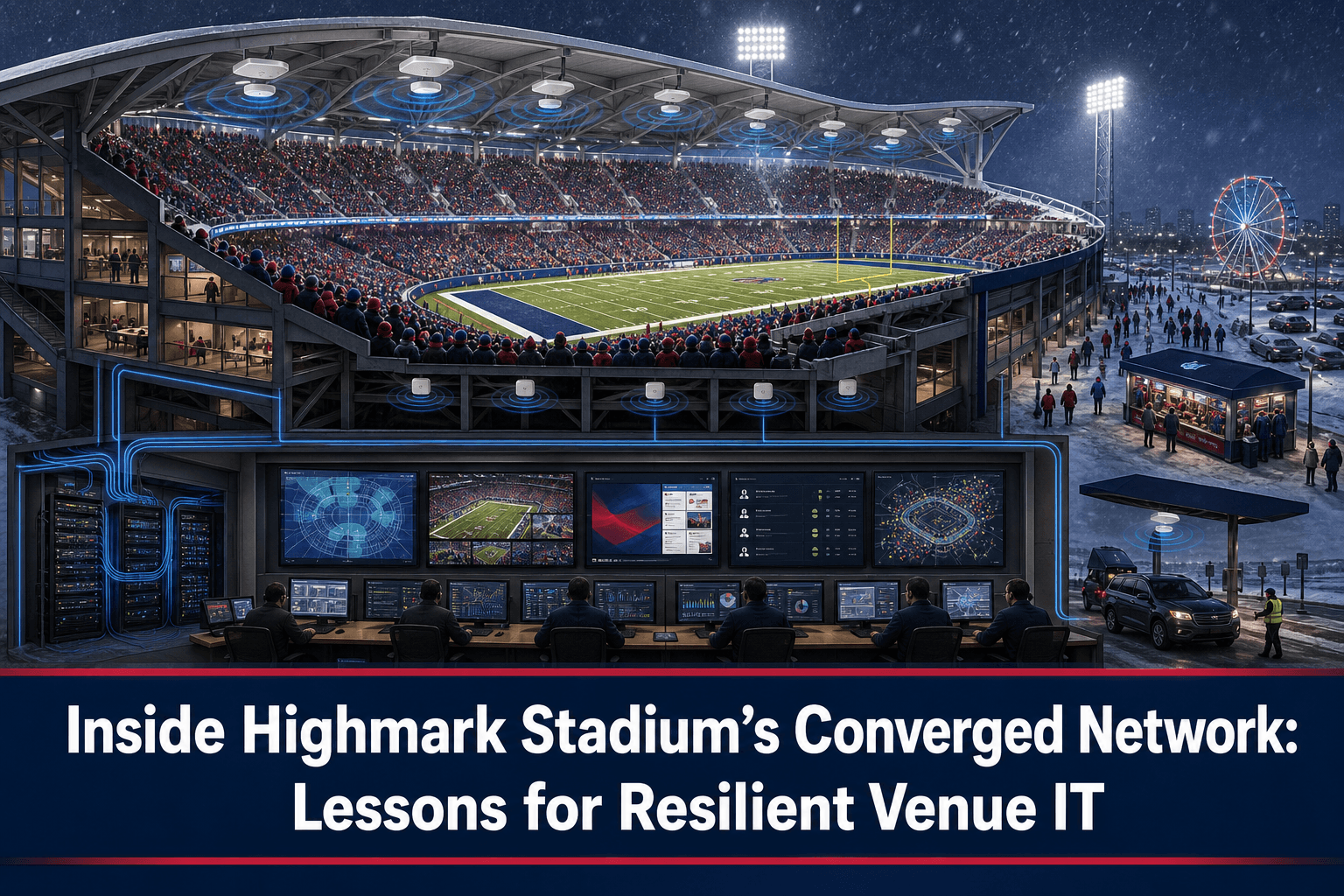
When the Buffalo Bills opened the new Highmark Stadium for their first regular-season game against the Detroit Lions, the most important infrastructure change was largely invisible to fans. Instead of carrying forward the former venue’s collection of separate systems, the organization built a converged Cisco environment intended to support the stadium as a whole.
The old stadium had separate Wi-Fi, core infrastructure, and other vendor-specific systems. According to Shaun Handley, IT infrastructure project director for the Bills, this fragmentation placed a continual burden on a lean IT team—even if spectators did not always experience that complexity directly.
“I really wanted to have robust infrastructure capable of supporting us into the future,” Handley said.
The goal was to reduce the need to move between multiple vendor environments, particularly on game days when approximately 60,000 people are in the venue. The Bills also required outside partners to integrate with the selected Cisco ecosystem rather than install equipment outside the team’s operational scope.
That decision illustrates an important distinction: convergence is not only about putting traffic onto a common network. It is also about defining ownership, integration boundaries, and who will be responsible for operating each component under pressure.
Wireless Design Shaped Around the Venue
Poor wireless service was one of the leading complaints at the former stadium. Fans struggled with basic calls and messages, let alone higher-bandwidth activities such as streaming.
The new venue uses Cisco Wi-Fi 7 with DB10 antennas installed in the stadium canopy. The design covers the 300 and 400 levels and reaches into the lower bowl, leaving under-seat access points necessary for only 20 rows. In total, approximately 1,300 access points cover about 64% of the venue, using fewer physical APs than a traditional deployment while reaching more space.
The reported usage figures show a dramatic change:
During a 2025 preseason game at the old stadium, fans used approximately 840 GB of Wi-Fi data.
During the 2026 preseason opener at Highmark Stadium, usage reached 16 TB.
That represents an increase of roughly 19 times.
These figures do more than demonstrate demand. They show why venue wireless design must reflect where people will actually be—not just where they sit during a football game.
Highmark Stadium also hosts concerts and other events where customers may occupy the field. Connectivity must therefore reach premium field seating as well as the stands. Coverage outside the building matters too, supporting uses such as pop-up merchandise kiosks and rideshare access.
Multiple Services on a Shared IP Foundation
The converged design extends beyond fan connectivity. The source identifies several services operating through the stadium’s IP environment:
Broadcast production uses the SMPTE 2110 standard over Cisco’s IP Fabric for Media.
Cisco Vision Edge supports digital signage across the venue.
Webex Calling provides staff communications.
Cisco Spaces sends location-based analytics to Splunk for insight into crowd flow and fan behavior.
Bringing these functions onto a common IP foundation can simplify operations and integration. It also changes the operational stakes: a configuration error or infrastructure problem may affect more than one service.
The published account does not detail the stadium’s redundancy, segmentation, failover, or recovery architecture. Those elements should therefore not be assumed. For IT leaders, however, they are central questions whenever broadcast, communications, analytics, signage, and public Wi-Fi share infrastructure.
Five Practical Lessons for IT Leaders
1. Define services and ownership before selecting components
The Bills did not simply replace individual devices. They established an operating model in which outside systems had to fit within a controlled environment. Every organization should determine who owns each asset, configuration, integration, and recovery procedure before deployment.
2. Design wireless coverage for every operating mode
A venue may behave differently during football games, concerts, setup periods, or post-event departures. Capacity plans should account for seating areas, fields, concourses, exterior kiosks, and transportation zones rather than optimizing for a single event format.
3. Treat convergence as a change-management challenge
A shared network reduces isolated technology silos, but it can increase the reach of individual changes. Configuration versioning, approval controls, tested rollback procedures, and current topology records become essential operational safeguards.
4. Measure outcomes, not only equipment counts
Highmark Stadium’s most meaningful wireless indicator is not simply its approximately 1,300 APs. The jump from 840 GB to 16 TB shows that fans were able and willing to use the service at a very different scale.
5. Plan resilience explicitly
Convergence alone does not guarantee resilience. IT teams should document shared dependencies and answer practical questions:
Which services depend on each network segment or device?
What happens if a configuration change fails?
How quickly can a known-good configuration be restored?
Are firmware vulnerabilities and end-of-life dates visible centrally?
Can compliance evidence be produced without manually checking every asset?
Are external partner devices covered by the same inventory and change controls?
How ConnectMyAssets Helps
Highmark Stadium is presented as a tightly controlled Cisco deployment, but most organizations still operate mixed estates across venues, campuses, data centers, and remote sites. ConnectMyAssets provides an on-prem, vendor-agnostic management layer for applying consistent operational controls across that broader infrastructure.
Dynamic CMDB and Topology maintain an inventory of network assets and their relationships, helping teams understand which services may depend on a planned change.
Backup & History versions device configurations and provides one-click rollback when a change must be reversed quickly.
Compliance Engine evaluates configurations against policies associated with NIS2, ISO 27001, PCI, CISA, and NIST requirements.
Per-asset CVE Tracking connects vulnerability information to the devices actually present in the environment.
End-of-Life Tracking identifies infrastructure approaching vendor support milestones.
Automation & ZTP help standardize repeatable deployments and reduce configuration drift.
IPAM, Firewall Management, Credential Vault, and SSH Bastion bring addressing, policy, access, and administrative workflows into the same controlled operational platform.
For a converged environment, the value is not merely centralized visibility. It is the ability to know what changed, verify whether configurations remain compliant, track exposure, and restore a known-good state when several services rely on the same network foundation.
The Broader Takeaway
Highmark Stadium demonstrates what becomes possible when network architecture is treated as a common service platform rather than a collection of unrelated systems. Its wireless usage, expanded coverage model, IP-based broadcast workflow, signage, staff communications, and location analytics all point to the benefits of designing the digital foundation as a whole.
The corresponding lesson is that operational discipline must grow with convergence. Accurate inventory, controlled configurations, recoverability, vulnerability awareness, and lifecycle planning are what turn a shared network into infrastructure the organization can operate with confidence.
Source: Network World