Network teams are ready to delegate more
Artificial intelligence is moving from advising network operators to taking corrective action. According to a Cisco and Omdia report covered by Network World, 51% of respondents already use agentic AI tools in production to take corrective action in real time.
The survey included 1,000 IT and network operations leaders. Its findings illustrate how quickly expectations are changing:
Three-quarters use AI in some form for network operations.
80% are comfortable giving AI a high or fully autonomous role.
56% would require a human to approve AI-proposed actions.
24% are comfortable with AI taking network actions without human oversight.
82% would allow AI to make at least some production changes autonomously for certain categories.
84% expect to reach a fully AI-led operating model within twelve months.
Cisco describes this progression from AIOps toward agent-powered operations as AgenticOps. The motivation is straightforward: networks are becoming more complex, while organizations have fewer people with the skills required to resolve difficult, cross-domain problems.
Autonomy is not the same as unrestricted access
The strongest signal in the survey is not enthusiasm for AI alone. It is the demand for control. Ninety-nine percent of respondents said they would not trust AI to act without guardrails.
The safeguards identified in the report include:
Explainable AI actions
Human approval for actions
Policy-based operational limits
Emergency override mechanisms
Role-based access control
Immutable audit trails
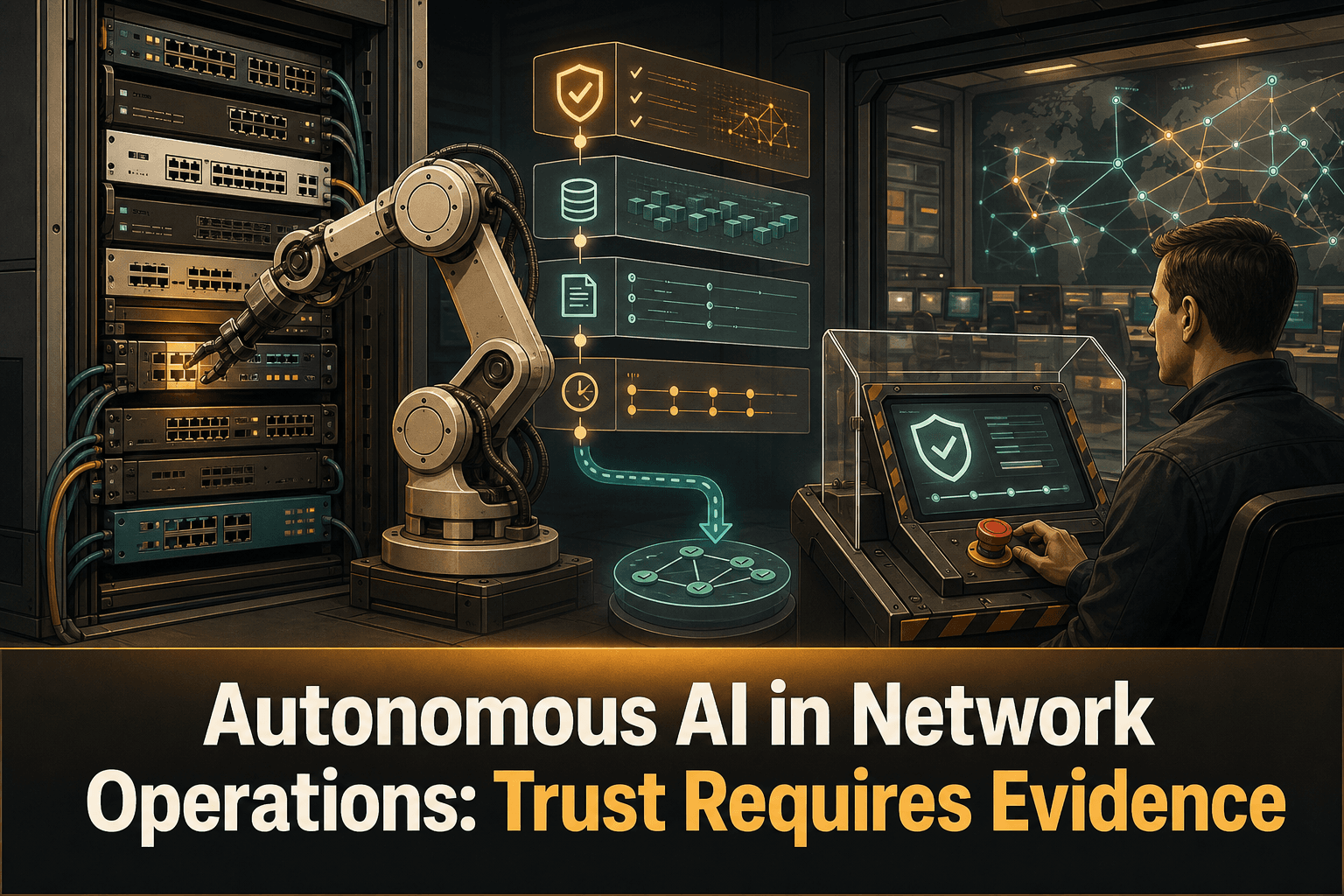
These controls address different parts of the same risk. Explainability helps operators understand why an agent reached a conclusion. Approval gates determine when a person must intervene. Policies and role-based access restrict what the agent may touch. Emergency overrides provide a way to stop unsafe behavior, while audit trails preserve evidence of what happened.
The report also describes agents constrained by defined skills, knowledge, and scopes of responsibility. Another cited constraint is preventing agents from communicating directly with other agents. The objective is to avoid giving a broadly capable system unrestricted authority across the environment.
A practical test before granting autonomy
Organizations assessing autonomous network operations should evaluate each proposed action category separately rather than making a single decision for the entire network.
Define the permitted scope. Identify the assets, configuration domains, and types of change the agent may handle.
Set approval thresholds. Separate advisory actions, human-approved execution, and narrowly defined autonomous execution.
Enforce least privilege. Give the agent only the credentials and access needed for its assigned task.
Capture the explanation. Preserve the reasoning, triggering evidence, intended change, and expected outcome.
Record the actual change. Compare the configuration before and after execution so operators can verify what was modified.
Prepare recovery first. Confirm that a known configuration is available and that rollback can be performed before permitting an autonomous production change.
Review outcomes. Use operational and configuration history to identify repeated failures, policy violations, or changes that should return to human approval.
This model allows autonomy to expand gradually, based on evidence. A low-risk, repeatable workflow can be treated differently from a change affecting critical routing, firewall policy, or shared infrastructure.
How ConnectMyAssets Helps
ConnectMyAssets provides an on-prem, vendor-agnostic management layer for building the operational controls that autonomous workflows require across multi-vendor infrastructure.
Dynamic CMDB maintains asset context, helping teams define which devices and infrastructure are within an automation scope.
Backup & History provides configuration versioning and one-click rollback, creating before-and-after evidence and a recovery path for managed assets.
Automation & ZTP supports repeatable workflows rather than unbounded changes.
Credential Vault and SSH Bastion help control how administrative access is granted and used.
Compliance Engine evaluates infrastructure against policies associated with NIS2, ISO 27001, PCI, CISA, and NIST requirements.
AI Insights, running locally, helps organizations analyze their infrastructure while retaining an on-prem operating model.
Per-asset CVE Tracking and End-of-Life tracking add risk context that can inform which assets should—or should not—be included in automated action scopes.
Configuration history is not automatically equivalent to the immutable audit trail called for in the survey. However, it supplies essential change evidence: what an asset looked like before an action, what changed, and which configuration can be restored. Organizations should combine that evidence with their approval records and required audit controls.
Build trust through reversible steps
Agentic operations may reduce repetitive work and help scarce specialists focus on higher-value problems. But trust should come from constrained authority, visible reasoning, controlled access, and verifiable outcomes—not from autonomy alone.
Before an AI agent receives permission to change production infrastructure, the organization should be able to answer three questions: What may it change? How will we prove what it changed? How will we restore the previous state?
Source: Network World