The Slow Death of SNMP: Why It’s Time to Move On
For decades, SNMP (Simple Network Management Protocol) has been the backbone of network monitoring. It powered dashboards, alerts, capacity planning, and fault management across enterprises and service providers alike.
And yet, despite its long reign, a growing consensus is emerging in the networking community:
SNMP is no longer fit for modern networks.
It’s not that SNMP suddenly stopped working. It’s that the world around it has fundamentally changed — and SNMP hasn’t kept up.
A Protocol From Another Era
SNMP was designed in the late 1980s for networks that were:
- Small and mostly static
- Managed manually by humans
- Composed of homogeneous hardware
- Lightly secured (if at all)
At the time, polling counters from devices every few minutes made sense.
Today’s networks, however, look nothing like that.
We now operate: - Highly dynamic infrastructures
- Hybrid environments (on-prem, cloud, edge)
- Virtualized and containerized network functions
- Massive device fleets with frequent changes
SNMP’s design assumptions simply no longer hold.
The Polling Problem
At the heart of SNMP lies polling.
Monitoring systems continuously ask devices questions like:
- “How many packets have you forwarded?”
- “What is your interface utilization?”
- “Are you still alive?”
This model introduces several fundamental issues: - Latency by design
You only know something went wrong after the next poll. - Scalability limits
Polling thousands of devices every few minutes does not scale gracefully. - Blind spots
Short-lived issues often go completely unnoticed. - Network overhead
Polling traffic grows linearly with device count.
Modern systems expect events, not delayed answers.
MIBs, OIDs, and Operational Pain
Anyone who has worked seriously with SNMP knows the pain:
- Vendor-specific MIBs
- Poor or outdated documentation
- Inconsistent implementations
- Counters that reset, overflow, or lie
An OID like:
1.3.6.1.4.1.9.9.187.1.2.3.1.5
may represent something critical — or something completely meaningless — depending on the platform, software version, or vendor interpretation.
This makes SNMP:
- Hard to automate
- Hard to normalize
- Hard to trust
Security: Always an Afterthought
SNMP security has always been problematic.
- SNMPv1 and v2 rely on clear-text community strings
- SNMPv3 exists, but is:
- Complex to deploy
- Poorly implemented by vendors
- Rarely used consistently
In a world where zero trust and strong authentication are standard, SNMP feels dangerously outdated.
The Industry Is Quietly Moving On
One of the strongest arguments against SNMP is not technical — it’s cultural.
Vendors are no longer innovating around SNMP.
Instead, we see:
- Rich REST APIs
- Streaming telemetry
- gRPC and model-driven interfaces
- Native integrations with cloud platforms
SNMP remains for backward compatibility, not innovation.
As one engineer bluntly put it:
“SNMP isn’t dead. It’s just no longer where progress happens.”
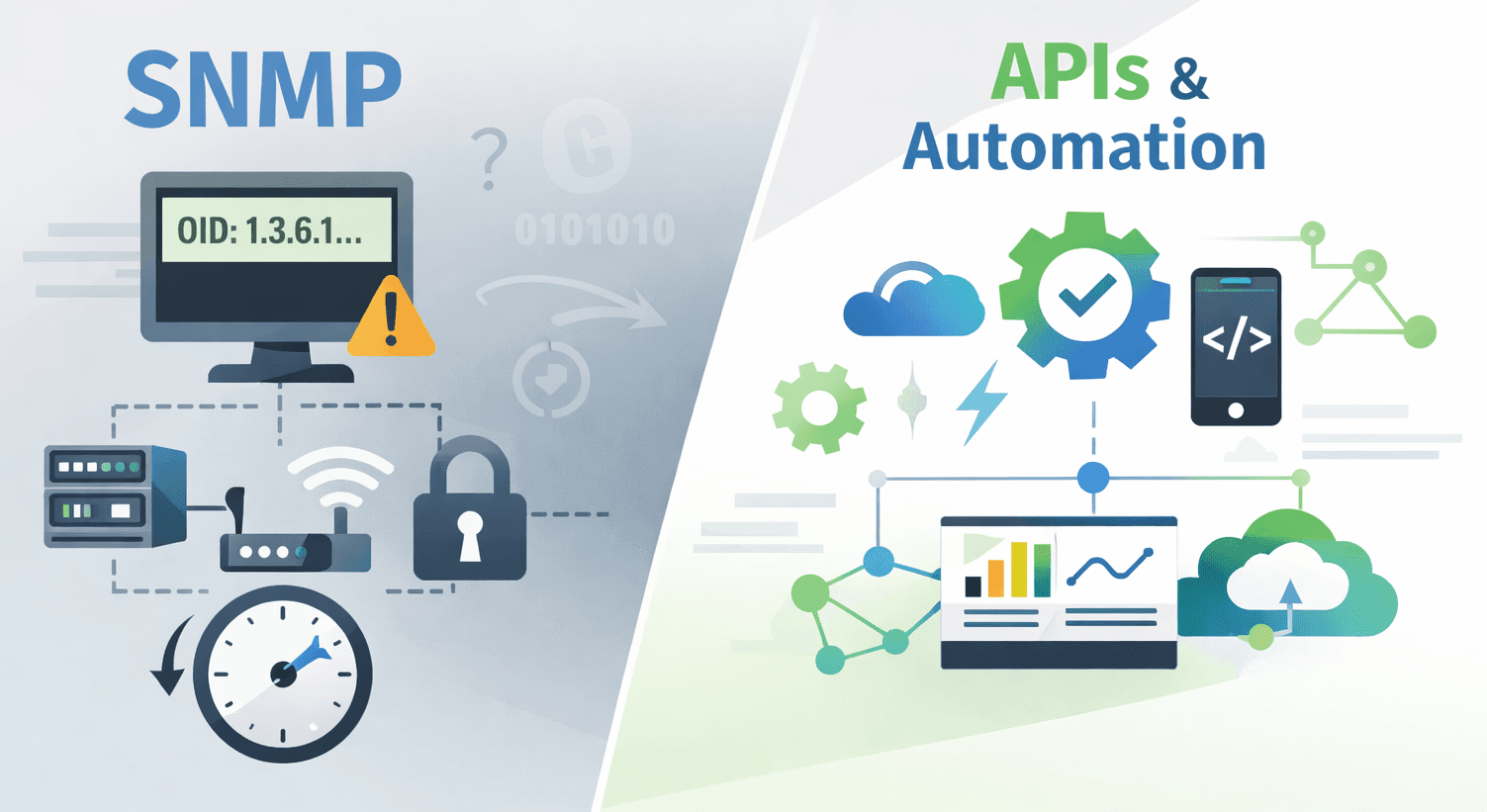
Life After SNMP: API-First Network Management
If SNMP is slowly fading away, the obvious question becomes: what replaces it?
The answer is not a single protocol, but a shift in philosophy.
Modern infrastructure management is increasingly API-driven, event-based, and tightly integrated with automation and observability stacks.
Instead of polling devices every few minutes and hoping the data is still relevant, modern platforms expose real-time, structured, and actionable data through APIs.
Why APIs Are a Better Fit Than SNMP
APIs fundamentally change the way we interact with network devices and platforms:
- Pull what you need, when you need it
- Structured, self-describing data (JSON > OIDs)
- Built-in security (OAuth, tokens, RBAC, TLS)
- Event-based models (webhooks, streaming APIs)
- Automation-first design
APIs treat the network as a software platform, not a black box to be scraped.
Modern Platforms Built for This Reality
A growing number of platforms have embraced this API-first approach.
Solutions like ConnectMyAssets illustrate this shift particularly well.
Rather than relying on legacy SNMP polling, ConnectMyAssets focuses on:
- Centralized and accurate network asset inventory
- Real-time visibility exposed through modern APIs
- Strong integration with external systems
- A data model designed for automation and analytics
This enables teams to: - Build custom monitoring and compliance workflows
- Correlate network data with CMDBs, IPAMs, and cloud inventories
- Detect anomalies without brittle SNMP counters
- Scale operations without increasing complexity
SNMP Isn’t Dead — But It’s No Longer the Center
SNMP will not disappear overnight.
It still exists.
It still works.
And in some legacy environments, it remains the only option.
But it should no longer be the foundation of modern network management.
Today:
- APIs are the primary interface
- SNMP is a compatibility layer
- Observability replaces raw polling
- Automation replaces manual interpretation
Conclusion
SNMP was designed for a world of static networks and human operators.
Modern networks demand:
- Dynamic systems
- Real-time insights
- Strong security
- Automation by default
The slow death of SNMP is not about abandoning the past —
it’s about embracing tools designed for the present and the future.
The future of network management isn’t about better MIBs.
It’s about better APIs.