Back to Blog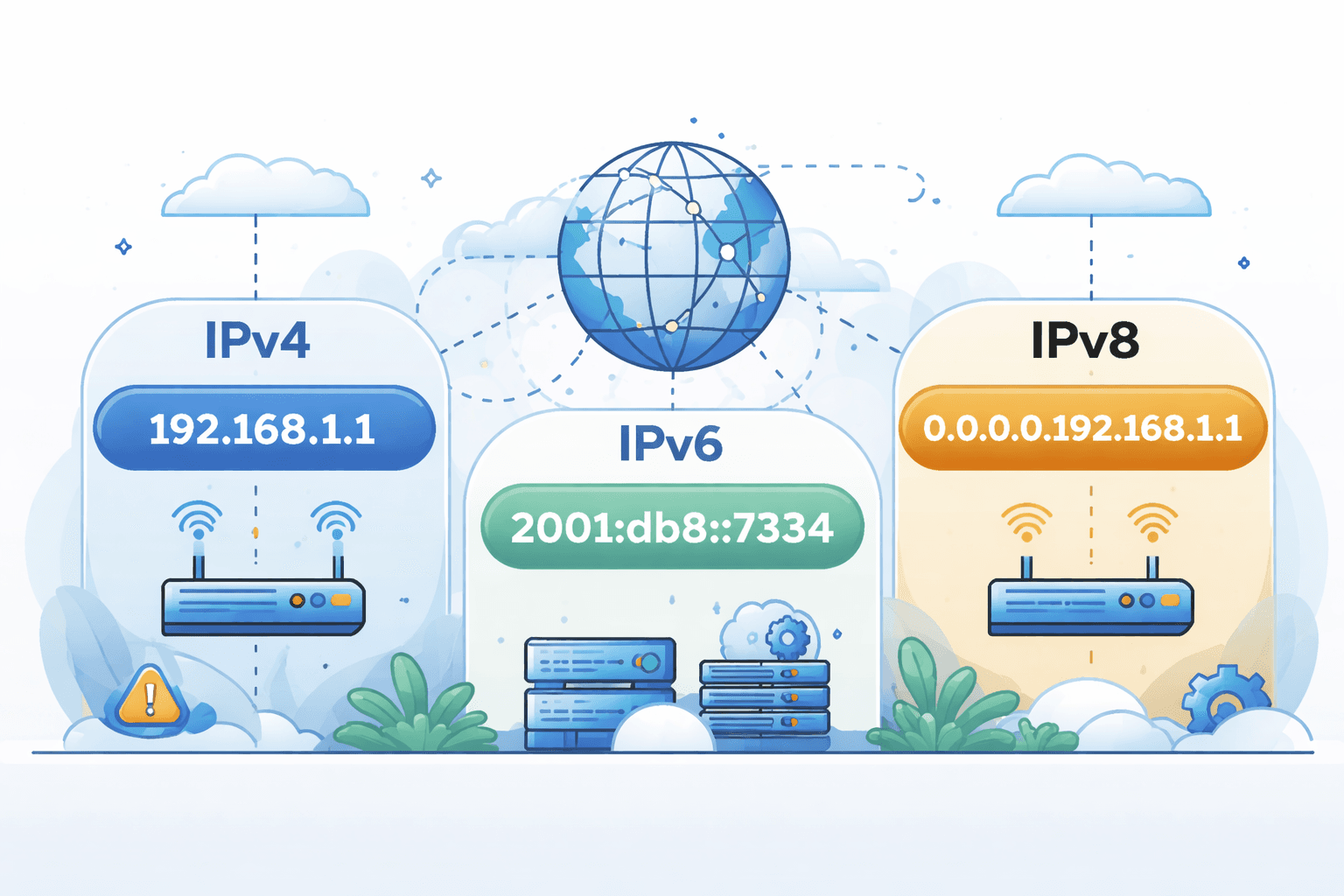
Network Management
April 20, 2026
5 views
IPv8: A New Hope for Internet Addressing
The Internet relies on IP (Internet Protocol) addresses to allow devices to communicate. However, the rapid growth of connected devices has created a major issue: the exhaustion of available IP addresses.
While IPv6 was introduced to solve this, its adoption has been slow. A new proposal, IPv8, aims to provide a simpler and more practical solution.
The Problem with IPv4
- Uses addresses like 192.168.1.1
- Based on 32-bit addressing
- Limited to about 4.3 billion addresses
- Now insufficient due to:
- Smartphones
- IoT devices
- Smart homes
- Connected vehicles
Why IPv6 Was Not Enough
- Uses 128-bit addressing
- Provides an almost unlimited number of addresses
- Complex hexadecimal format (2001:db8::7334)
- Difficult migration process
- Requires dual-stack (IPv4 + IPv6)
What Is IPv8?
IPv8 is a new Internet-Draft proposal from the IETF.
- Uses 64-bit addressing
- Keeps a structure similar to IPv4
- Fully backward compatible with IPv4
- IPv4 becomes a subset of IPv8
Example:
- IPv4 → 192.168.1.1
- IPv8 → 0.0.0.0.192.168.1.1
How IPv8 Works
Address format: r.r.r.r.n.n.n.n
Split into:
- 32-bit routing prefix (ASN)
- 32-bit host (IPv4 part)
Total address space:
- 2^64 addresses (~18 quintillion)
Key Features of IPv8
- No need for dual-stack
- Compatible with existing IPv4 devices
- Easier deployment than IPv6
- Simplified routing system
- Integrated network services (DNS, DHCP, security unified)
Advantages
- Simpler than IPv6
- Faster potential adoption
- Minimal infrastructure changes
- Scalable enough for future needs
Limitations
- Still an experimental draft (not a standard)
- Less address space than IPv6
- Requires global adoption to succeed
- Competes with already deployed IPv6
Conclusion
IPv8 is an interesting attempt to rethink Internet addressing by combining the simplicity of IPv4 with modern scalability.
However, it is still at an early stage and its adoption will depend on whether the networking community supports it.