The Network’s “Test in Production” Problem
Software developers expect version control, staging environments, and automated regression testing. Network engineers often have no equivalent environment, leaving production as the place where configuration changes are ultimately tested.
That approach was already risky when engineers made one change at a time during a maintenance window. It becomes a much greater liability when AI agents can propose or execute changes at machine speed. Before autonomous operations can be trusted, teams need a way to predict the consequences of a change without exposing the live network.
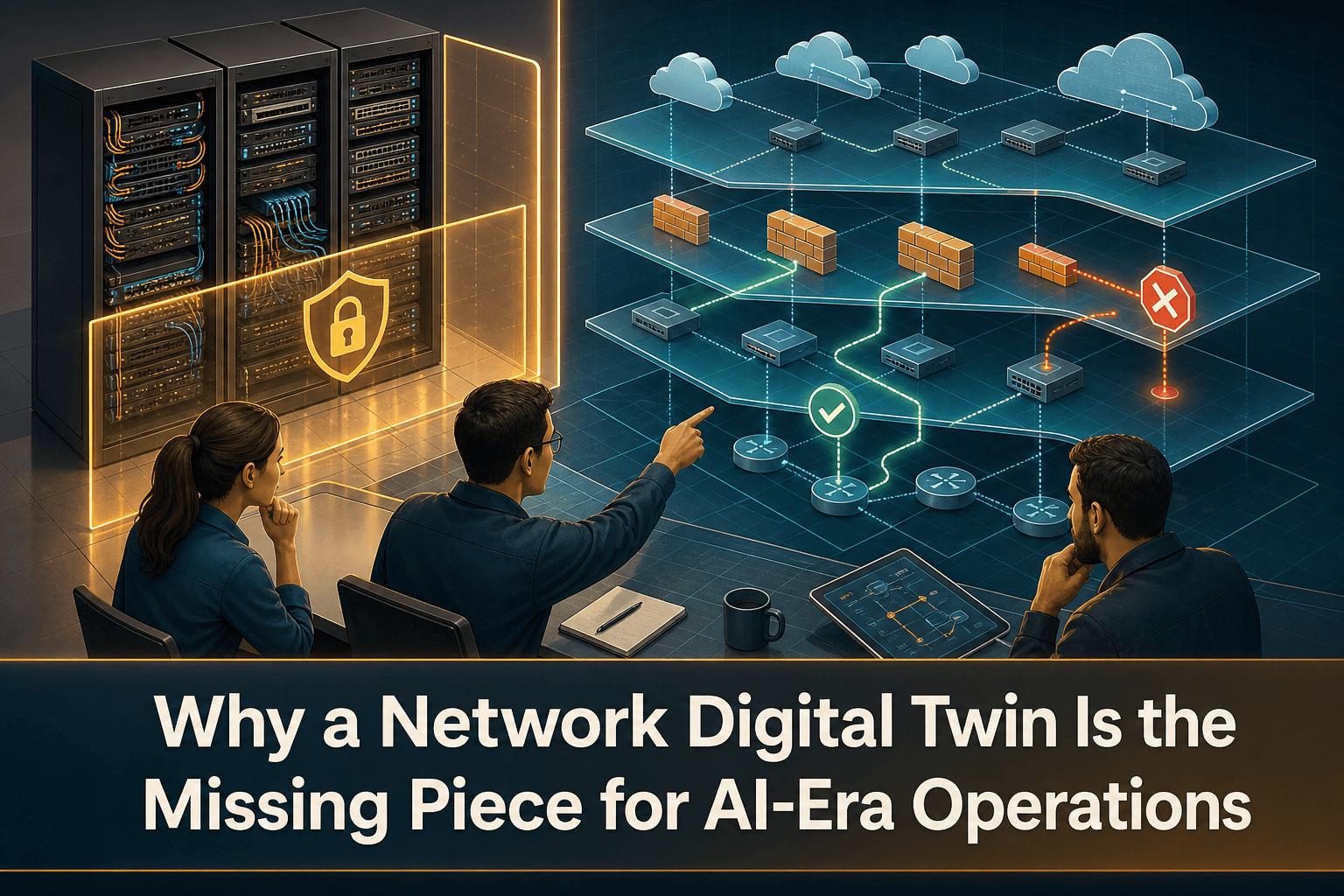
A vendor-neutral network digital twin addresses this gap by representing devices, configurations, state, and traffic paths across the production environment. Engineers—and eventually AI-assisted workflows—can query that representation to determine whether the network’s actual behavior matches its intended behavior.
What Makes a Network Digital Twin Different?
The term digital twin covers two distinct technical approaches:
Emulation runs actual device firmware against defined test scenarios. It shows what happened in the scenarios that were executed.
Deterministic mathematical modeling uses network configuration and state to calculate forwarding behavior across paths. Its goal is to reason about possible behavior beyond a limited set of test cases.
As the guide cited by Network World puts it:
“An emulated replica tells you what happened when you tested it. A mathematical model tells you what will happen, for every path, every time.”
This also distinguishes a digital twin from observability. Monitoring shows what is happening at selected points now. A digital twin is intended to answer broader questions: Where can traffic go across vendors, clouds, and network layers? Does that reachability match business and security intent? What would change if a proposed configuration were applied?
Closing the Intent-Reality Gap
Every network begins with an intended design for connectivity, security, and resilience. Once deployed, that design starts to drift. Devices are added, firewall rules are amended, exceptions accumulate, and documentation falls behind.
This creates an intent-reality gap. Teams may know what the network was designed to do without being able to prove what it does today.
That uncertainty has operational consequences:
Security patches and operating-system upgrades may be deferred because their blast radius is unclear.
Firewall changes can remain under review while engineers manually assess dependencies.
Necessary modernization slows because teams fear triggering an outage.
Documentation becomes less reliable as production continues to change.
The figures cited in the source illustrate the stakes. Drawing on Verizon’s 2025 Data Breach Investigations Report, the digital-twin guide says exploitation of vulnerabilities in edge devices such as VPNs, firewalls, and routers rose from 3% to 22% of breaches year over year. It also reports that only 54% of network vulnerabilities are remediated annually, with an average remediation time of 32 days.
Network World also notes cited estimates of more than $500,000 per hour for an unplanned production network outage and more than $10 million per incident for a U.S. data breach. These figures reinforce why change confidence is not simply a productivity concern.
A Safer Foundation for AI Operations
AI can accelerate analysis and change generation, but speed does not establish correctness. An AI-generated command can still reflect incomplete inventory data, stale configurations, undocumented exceptions, or an incorrect assumption about reachability.
A digital twin can provide a validation layer between recommendation and execution. A controlled workflow could:
Capture the current inventory, configuration, and relevant network state.
Model the proposed change outside production.
Test expected reachability, isolation, and resilience outcomes.
Identify unintended paths or affected dependencies.
Require approval when policy or risk thresholds are crossed.
Apply the approved change and verify the resulting state.
Preserve the before-and-after evidence for audit and rollback.
The important principle is that AI should not act solely on a plausible explanation. It should act on current evidence, explicit policy, and validated outcomes.
How ConnectMyAssets Helps
ConnectMyAssets provides an on-premises, vendor-agnostic management layer for building the operational evidence around network change. It does not replace the deterministic mathematical modeling described in the source; instead, its modules help maintain the trusted inventory, configuration history, controls, and execution records that safe testing and evidence-driven operations require.
Dynamic CMDB maintains an up-to-date inventory of multi-vendor network assets, reducing reliance on incomplete documentation.
Backup & History preserves configuration versions and provides one-click rollback, giving teams a known pre-change state and a recovery path.
Topology helps operators understand relationships and dependencies before approving a modification.
Firewall Management brings firewall changes into a structured operational workflow rather than treating them as isolated rule edits.
Compliance Engine assesses infrastructure against NIS2, ISO 27001, PCI, CISA, and NIST requirements, helping teams connect proposed changes to explicit controls.
Per-asset CVE Tracking links known vulnerabilities to the assets that may require remediation, supporting risk-based patch prioritization.
AI Insights, processed locally, can assist analysis while keeping infrastructure data on premises.
Automation & ZTP can execute approved, repeatable actions after appropriate validation rather than turning every recommendation directly into a production command.
For organizations adopting a separate mathematical digital twin, ConnectMyAssets can support the broader lifecycle: maintaining source evidence, preserving configurations, tracking vulnerabilities and compliance, controlling execution, and recording the resulting state. This creates a more defensible path from observation to validation to approved action.
Digital Twins Need Reliable Inputs and Governance
A digital twin is not a shortcut around operational discipline. Its conclusions depend on the completeness and freshness of the device, configuration, and state data it receives. AI operations introduce the same requirement at a larger scale.
The practical objective is therefore not autonomy at any cost. It is a closed operational loop in which:
The real environment is continuously documented.
Proposed changes are tested away from production.
Policy determines whether execution is allowed.
Automation performs approved actions consistently.
Post-change evidence confirms whether intent and reality still align.
Configuration history supports investigation and rollback.
Networks have operated without a true staging environment for decades. AI makes that deficiency harder to tolerate. A vendor-neutral digital twin, supported by accurate asset data, configuration history, compliance controls, and governed automation, offers a safer basis for the next generation of network operations.
Source: Network World