What Is NAC?
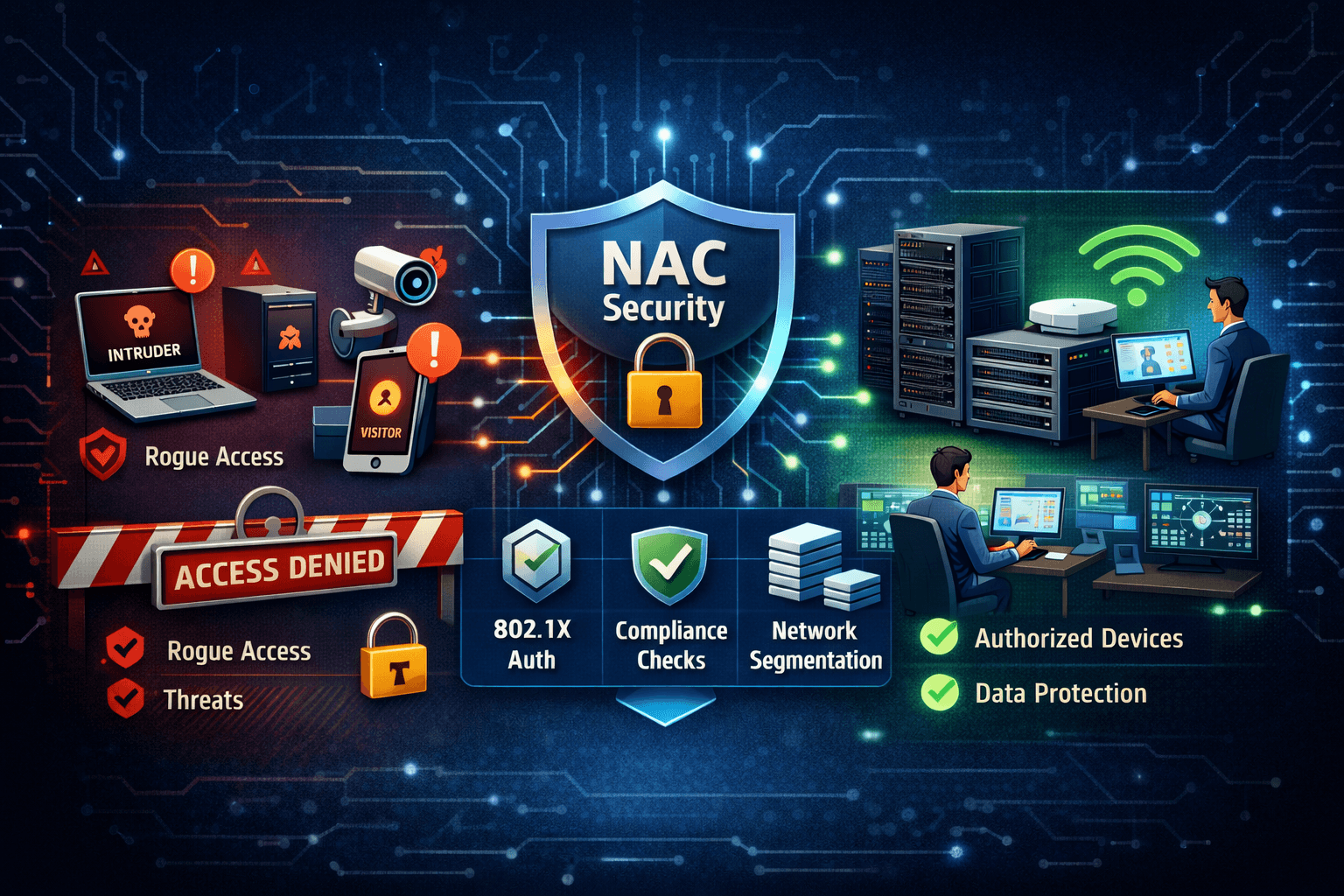
Network Access Control (NAC) is a security framework that controls how devices connect to a network.
It verifies:
Who is connecting
What device is connecting
Whether the device is compliant
Where the device is allowed to connect
Before granting access, NAC evaluates the device against predefined security policies.
Why Traditional LAN Security Is No Longer Enough
Many organizations still rely on outdated security models based on perimeter defense.
Typical weaknesses include:
Open Ethernet ports
Shared Wi-Fi credentials
No device authentication
Flat network architecture
Limited visibility
These weaknesses make internal networks vulnerable to:
Rogue devices
Infected laptops
Unauthorized IoT equipment
Insider threats
Shadow IT
Once inside, attackers often move laterally without resistance.
Key Benefits of Implementing NAC
A properly deployed NAC solution provides several strategic advantages.
1. Strong Device Authentication
NAC ensures that every device is authenticated before accessing the LAN.
This can be achieved using:
802.1X authentication
Certificates
RADIUS servers
Multi-factor authentication
Result:
Only trusted users and devices can connect.
2. Device Compliance Enforcement
NAC checks whether endpoints meet security requirements.
Typical compliance criteria include:
Updated operating system
Active antivirus
Enabled firewall
Latest security patches
Encrypted storage
Non-compliant devices can be:
Blocked
Isolated
Redirected to remediation networks
3. Network Segmentation and Access Control
NAC dynamically assigns devices to network segments.
Examples:
Employees → Corporate VLAN
Guests → Internet-only VLAN
IoT → Restricted VLAN
Contractors → Limited-access VLAN
This reduces attack surfaces and limits lateral movement.
4. Improved Visibility and Asset Management
With NAC, IT teams gain full visibility over connected devices.
They can easily identify:
Device type
Operating system
MAC address
User identity
Connection history
This creates a real-time inventory of network assets.
5. Support for Compliance and Regulations
Many regulatory frameworks require strict access controls.
NAC helps organizations meet requirements from:
ISO 27001
NIS2
GDPR
PCI-DSS
HIPAA
By enforcing authentication and logging, NAC provides strong audit evidence.
Risks of Operating Without NAC
Organizations that do not deploy NAC expose themselves to significant risks.
Common consequences include:
Data breaches
Ransomware propagation
Network outages
Compliance violations
Financial penalties
In many incidents, attackers enter through unsecured internal ports.
Real-World Scenario: How NAC Prevents Breaches
Imagine a contractor connects an infected laptop to a meeting room port.
Without NAC:
The device gets full network access
Malware spreads laterally
File servers are compromised
Business operations stop
With NAC:
The device fails compliance checks
It is placed in quarantine
IT is alerted
No damage occurs
The difference is immediate and measurable.
Core Components of a NAC Architecture
A typical NAC deployment includes:
Authentication server (RADIUS)
Certificate authority (PKI)
Policy engine
Network devices (switches/APs)
Endpoint agents (optional)
Monitoring dashboard
All components work together to enforce access policies.
Best Practices for Deploying NAC
Successful NAC projects require careful planning.
Recommended practices:
Start with monitoring mode
Inventory existing devices
Define clear access policies
Use certificate-based authentication
Segment critical systems
Integrate with SIEM
Document procedures
Train IT staff
Gradual deployment reduces operational risks.
Common Challenges and How to Overcome Them
Complexity
NAC can be technically demanding.
Solution:
Use phased rollouts
Pilot on limited segments
Work with experienced integrators
Legacy Devices
Some equipment does not support modern authentication.
Solution:
Use MAC Authentication Bypass (MAB)
Place devices in restricted VLANs
Plan hardware refresh cycles
User Resistance
Users may perceive NAC as restrictive.
Solution:
Communicate security goals
Automate onboarding
Provide self-service portals
NAC and Zero Trust Strategy
NAC is a fundamental pillar of Zero Trust networking.
It supports Zero Trust principles:
Never trust by default
Always verify identity
Enforce least privilege
Continuously monitor
Without NAC, Zero Trust cannot be fully implemented on the LAN.
Supporting NAC Compliance with Automation
Maintaining NAC policies across hundreds of switches can be challenging.
Tools like ConnectMyAssets can help identify configuration drifts and detect non-compliant NAC settings on network devices, making audits and remediation more efficient.
Conclusion: NAC Is a Strategic Investment
Network Access Control is not just a technical feature.
It is a strategic security control that:
Protects sensitive data
Reduces attack surfaces
Ensures regulatory compliance
Improves network visibility
Strengthens operational resilience
In modern enterprises, running a LAN without NAC is no longer acceptable.
It is not a matter of if you will be attacked — but when.
And NAC determines whether that attack succeeds.