Network management · 1 MIN READ

IPv8: A New Hope for Internet Addressing

The Internet relies on IP (Internet Protocol) addresses to allow devices to communicate. However, the rapid growth of connected devices has created a major issue: the exhaustion of available IP addresses. While IPv6 was introduced to solve this, its adoption has been slow. A new proposal, IPv8, aims to provide a simpler and more practical solution.

IPv8: A New Hope for Internet Addressing

The Problem with IPv4

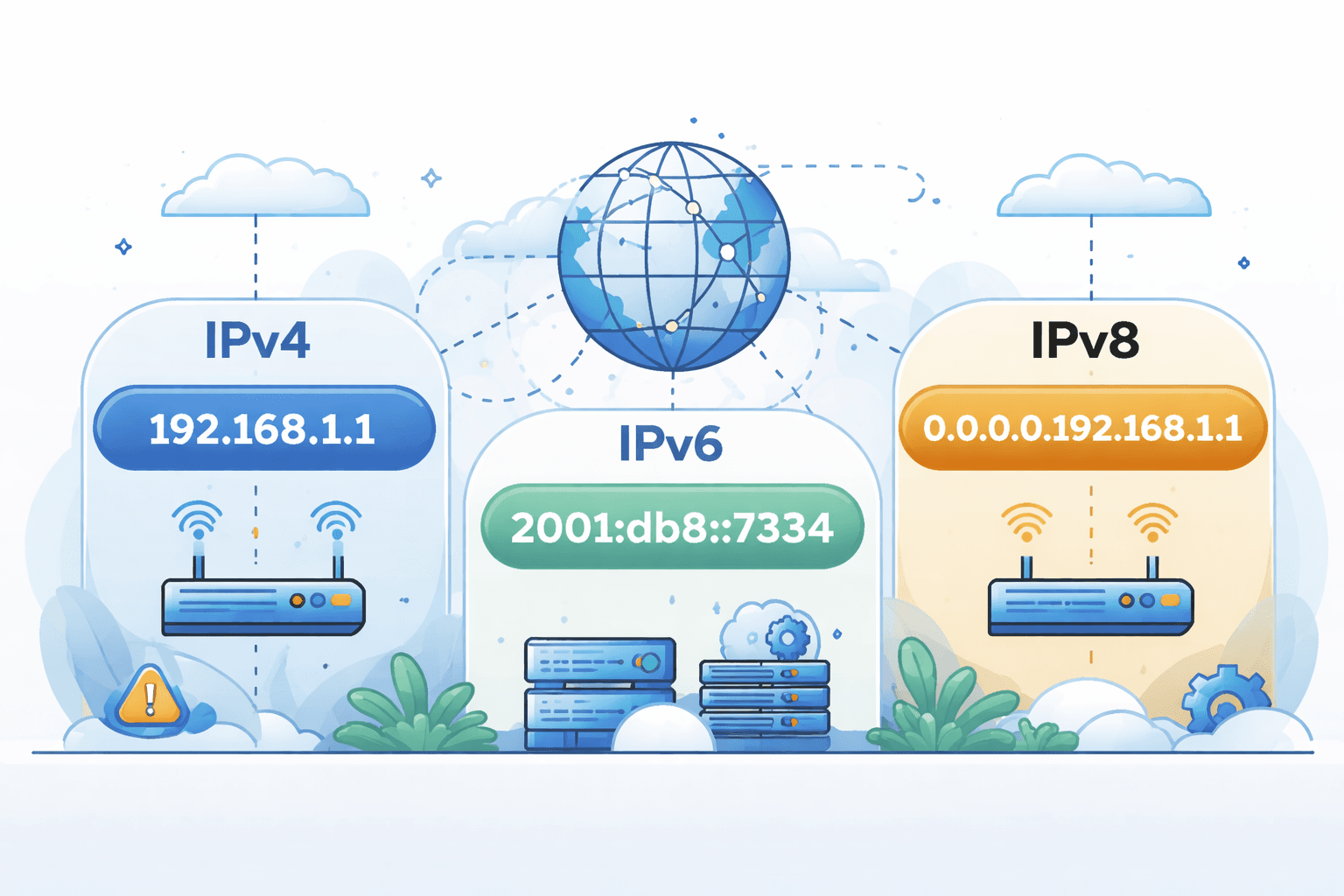
  • Uses addresses like 192.168.1.1

  • Based on 32-bit addressing

  • Limited to about 4.3 billion addresses

  • Now insufficient due to:

    • Smartphones

    • IoT devices

    • Smart homes

    • Connected vehicles


Why IPv6 Was Not Enough

  • Uses 128-bit addressing

  • Provides an almost unlimited number of addresses

  • Complex hexadecimal format (2001:db8::7334)

  • Difficult migration process

  • Requires dual-stack (IPv4 + IPv6)


What Is IPv8?

IPv8 is a new Internet-Draft proposal from the IETF.

  • Uses 64-bit addressing

  • Keeps a structure similar to IPv4

  • Fully backward compatible with IPv4

  • IPv4 becomes a subset of IPv8

Example:

  • IPv4 → 192.168.1.1

  • IPv8 → 0.0.0.0.192.168.1.1


How IPv8 Works

  • Address format: r.r.r.r.n.n.n.n

  • Split into:

    • 32-bit routing prefix (ASN)

    • 32-bit host (IPv4 part)

  • Total address space:

    • 2^64 addresses (~18 quintillion)


Key Features of IPv8

  • No need for dual-stack

  • Compatible with existing IPv4 devices

  • Easier deployment than IPv6

  • Simplified routing system

  • Integrated network services (DNS, DHCP, security unified)


Advantages

  • Simpler than IPv6

  • Faster potential adoption

  • Minimal infrastructure changes

  • Scalable enough for future needs


Limitations

  • Still an experimental draft (not a standard)

  • Less address space than IPv6

  • Requires global adoption to succeed

  • Competes with already deployed IPv6


Conclusion

IPv8 is an interesting attempt to rethink Internet addressing by combining the simplicity of IPv4 with modern scalability.

However, it is still at an early stage and its adoption will depend on whether the networking community supports it.
Share this articleLinkedIn ↗Email ↗

Keep exploring.

All articles
Network management

How SR-MPLS Supports MPLS/VPN Operations

SR-MPLS can serve as a drop-in replacement for the traditional MPLS control plane while supporting MPLS/VPN services when properly implemented. The scenario also highlights why configuration history, compliance checks, topology visibility, and controlled automation matter in day-to-day network operations.

Read article
Network management

I Want to Break Free : Reclaim Your Network, Reclaim Your Data

Digital sovereignty is no longer just a strategic concept—it’s a critical requirement for any organization that wants to stay in control of its infrastructure, its data, and ultimately its future. Yet today, many companies unknowingly give up that control. They rely on vendor platforms to manage their network equipment, store their data, and define how their infrastructure operates. What seems convenient at first quickly turns into dependency.

Read article
Network management

Dynamic Network Topology: The Key to Network Visibility in Modern Enterprises

Modern enterprise networks are more complex than ever. Switches, routers, firewalls, trunk links, VLAN segmentation, wireless infrastructure… all these components create environments where understanding the real network architecture becomes difficult. Yet many organizations still rely on static network diagrams created in tools like Visio or Draw. The reality is simple: Static diagrams cannot keep up with modern networks.

Read article