Investigating What TLS Conceals
Encryption protects data in transit, but it also limits what defenders can inspect directly. Cisco’s account from Splunk .conf demonstrates a practical alternative: analyze signals associated with encrypted traffic, then use retained packet captures to investigate suspicious activity retrospectively.
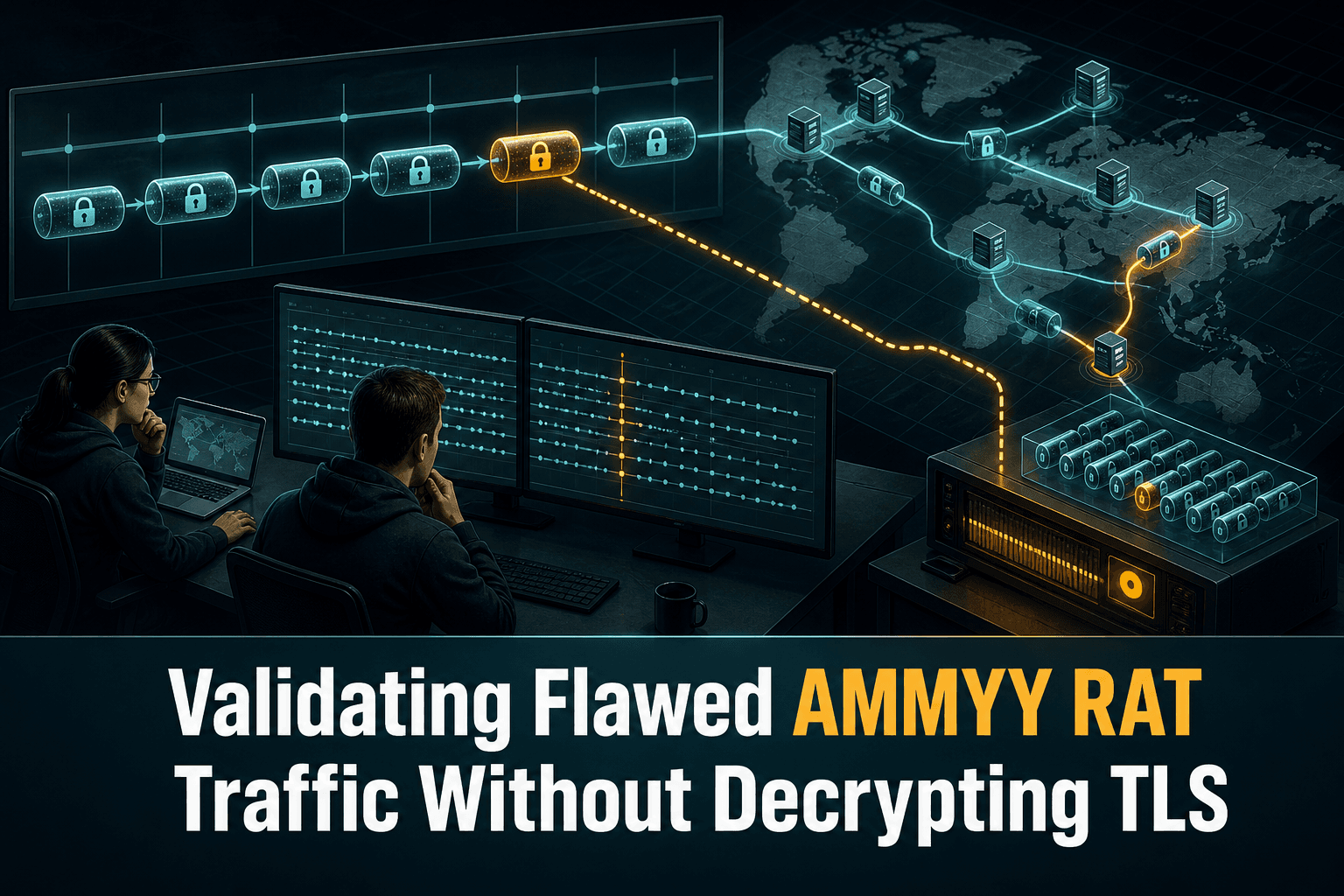
The case involved Flawed AMMYY RAT traffic. Cisco’s Encrypted Visibility Engine (EVE) and Endace PCAP were used to uncover and examine that activity without breaking TLS encryption.
The important lesson is not that encryption must be removed, but that suspicious encrypted sessions can still produce useful investigative evidence.
Two Complementary Layers of Evidence
The investigation highlights the value of combining two different capabilities.
Encrypted-traffic visibility
Cisco EVE provided visibility into suspicious encrypted network activity without requiring access to the TLS plaintext. This creates an investigative lead while preserving the encrypted session.
Such a signal should be treated as a starting point rather than the entire case. Defenders still need context to determine which systems communicated, when the activity occurred, and whether the observed traffic supports the initial suspicion.
Retrospective packet capture
Endace PCAP supplied the packet-level record needed to revisit the activity. Retrospective capture is particularly useful when an alert becomes meaningful only after the traffic has already crossed the network.
The combined workflow is straightforward:
Detect or flag suspicious behavior associated with encrypted traffic.
Identify the relevant communication and time window.
Retrieve the corresponding packet capture.
Review the available network evidence without decrypting the TLS payload.
Correlate the finding with the assets involved and determine the appropriate response.
This approach preserves encryption while giving investigators a way to validate activity against recorded network traffic.
Why Retrospective Evidence Matters
A real-time alert is only one moment in an investigation. Stored PCAP allows defenders to return to the original traffic rather than relying exclusively on an alert summary.
That distinction can help teams:
Corroborate suspicious encrypted-traffic observations.
Reconstruct the sequence and timing of communications.
Identify the network assets associated with the activity.
Preserve evidence for incident analysis.
Investigate after new information makes earlier traffic relevant.
The Cisco and Endace example also illustrates an architectural principle: encrypted-traffic analytics and packet retention serve different purposes. The first surfaces activity worth investigating; the second provides historical network evidence that can be reviewed later.
How ConnectMyAssets Helps
ConnectMyAssets does not replace encrypted-traffic analytics or a packet-capture platform. It complements this investigation by connecting network evidence to the infrastructure being managed.
Once suspicious traffic has been associated with a device, several ConnectMyAssets modules can support the next steps:
Dynamic CMDB: identify the asset and place it in its operational network context.
Backup & History: review configuration versions, look for relevant changes, and restore a known configuration with one-click rollback when appropriate.
Per-asset CVE Tracking: examine known vulnerability exposure for the systems involved without inventing a connection between the observed traffic and an unverified CVE.
Compliance Engine: assess the affected asset against applicable NIS2, ISO 27001, PCI, CISA, or NIST controls.
Automation: apply approved remediation or validation workflows consistently across selected infrastructure.
End-of-Life Tracking: determine whether an implicated device has reached, or is approaching, a lifecycle state that affects the response plan.
Because ConnectMyAssets is an on-premises, vendor-agnostic platform, asset, configuration, compliance, and vulnerability context can remain within the organization’s own environment. The operational sequence becomes clearer: encrypted-traffic visibility raises the lead, retrospective PCAP supports validation, and ConnectMyAssets helps infrastructure teams assess and manage the affected assets.
A Practical Model for Encrypted Investigations
The Splunk .conf investigation shows that defenders do not always need to decrypt TLS to pursue suspicious activity. Encrypted visibility can direct attention to a session, and retrospective PCAP can preserve the network evidence needed to examine it later.
For network teams, the broader takeaway is to connect that evidence with accurate asset inventory, configuration history, vulnerability context, and compliance status. Detection explains where to look; infrastructure context helps determine what to do next.
Source: Cisco