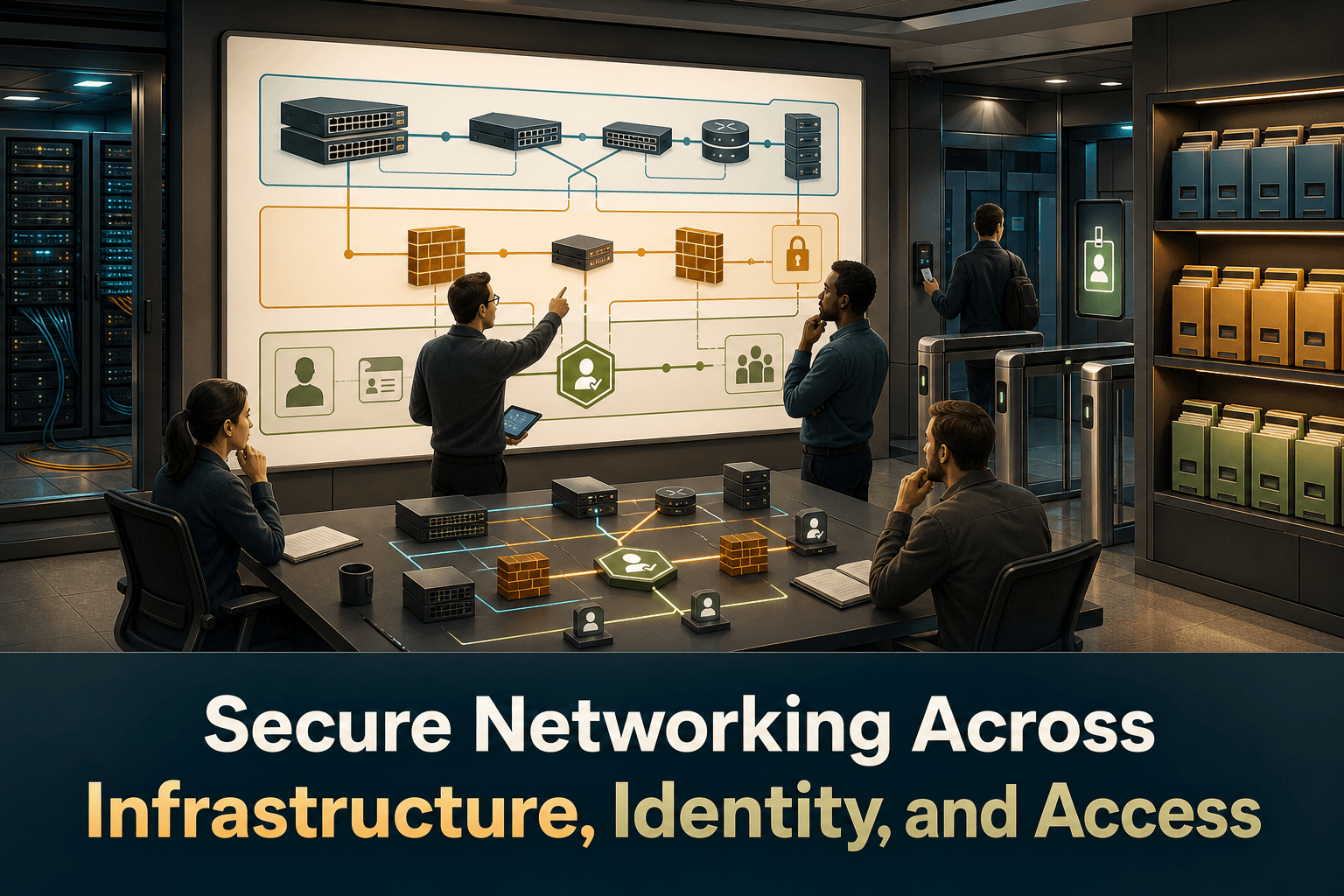
Cisco’s Secure Networking Ecosystem Insights webinar series is now available on demand. Its central theme—building a secure, ecosystem-driven network architecture across infrastructure, identity, and access—is especially relevant to teams responsible for heterogeneous estates.
The practical takeaway is broader than any single product or vendor. Secure networking depends on how consistently an organization discovers assets, controls administrative access, tracks configuration changes, addresses vulnerabilities, and retains evidence.
Treat Security as an Architecture, Not a Device Feature
Infrastructure, identity, and access are closely related operational domains:
Infrastructure includes the network devices and security appliances that carry, route, and inspect traffic.
Identity determines who or what is requesting access.
Access translates identity and policy into permitted actions.
A weakness in one area can undermine controls elsewhere. A well-configured firewall, for example, does not compensate for unmanaged administrator credentials or an undocumented configuration change. Conversely, strong identity controls cannot establish whether every network asset is known, supported, and configured according to policy.
For multi-vendor environments, the first architectural question should therefore be: Can we maintain consistent visibility and governance without assuming that every device belongs to one vendor ecosystem?
Build Around a Reliable Asset Record
Secure operations begin with an accurate understanding of the environment. Teams need to know which assets exist, how they relate to each other, and which operational details require attention.
A practical asset-management process should help teams:
Discover and inventory infrastructure across vendors.
Associate configuration history with the relevant asset.
Track known vulnerabilities on a per-asset basis.
Identify equipment approaching or reaching end of life.
Preserve topology and dependency context for operational decisions.
This record should remain dynamic. A static inventory can quickly diverge from the real network as devices, configurations, and relationships change.
Connect Administrative Identity to Controlled Access
Network administration is a privileged activity. Architecture reviews should examine not only whether users authenticate, but also how credentials and management sessions are handled.
Useful questions include:
Are device credentials stored in a controlled vault rather than scattered among scripts and personal records?
Is administrative SSH access routed through a defined bastion point?
Can the organization determine which asset was accessed and manage the credentials used for that access?
Are automation workflows using governed credentials rather than embedded secrets?
These controls reduce fragmentation around privileged access. They also help establish a clearer operational trail when investigating changes or assembling audit evidence.
Make Configuration History Part of the Security Model
A secure architecture must account for change. Current configuration alone does not explain how a device reached its present state or whether an unauthorized or unsuccessful modification occurred.
Configuration versioning supports several practical needs:
Detecting and reviewing changes.
Comparing current and earlier configurations.
Preserving historical evidence.
Recovering from an unwanted change through rollback.
Verifying whether policy requirements remain satisfied after maintenance.
This is particularly important in heterogeneous networks, where backup and change practices can otherwise vary by platform or device family.
Design Compliance Evidence Into Operations
Compliance evidence is strongest when it is produced by routine network-management processes rather than reconstructed shortly before an audit. Asset records, configuration versions, compliance checks, vulnerability status, and end-of-life information can all contribute to an evidence trail.
Teams should define:
Which controls can be checked against device configurations.
How failures are recorded and assigned for remediation.
How evidence is retained over time.
How exceptions and accepted risks are documented.
How the same process is applied across different vendors.
Frameworks and regulations may differ, but repeatable evidence collection remains a common operational requirement.
How ConnectMyAssets Helps
ConnectMyAssets provides an on-prem, vendor-agnostic platform for managing heterogeneous network infrastructure. Several modules directly support the architecture and evidence practices highlighted above:
Dynamic CMDB maintains a current asset record and infrastructure context.
Backup & History provides configuration versioning and one-click rollback.
Compliance Engine evaluates network configurations against requirements associated with NIS2, ISO 27001, PCI, CISA, and NIST.
Per-asset CVE Tracking connects known vulnerability information to the affected infrastructure.
Credential Vault and SSH Bastion support controlled handling of administrative credentials and access.
End-of-Life Tracking helps identify lifecycle risk within the installed estate.
Topology records relationships that matter during change analysis and incident response.
Automation & ZTP helps teams apply repeatable operational workflows across infrastructure.
Because ConnectMyAssets operates on premises and across vendors, teams can apply common management and evidence practices without requiring the entire network to belong to one proprietary ecosystem.
Questions to Take Into the Webinar Series
Cisco’s on-demand series can serve as a prompt for reviewing your own architecture. As you watch, consider asking:
Where are infrastructure, identity, and access decisions currently disconnected?
Which assets fall outside centralized inventory and configuration-history processes?
Can administrative access be traced to controlled credentials and workflows?
Is compliance evidence generated continuously or assembled manually?
Are vulnerability and end-of-life risks visible at the individual asset level?
Can common policies be applied across the vendors already deployed?
The goal is not simply to add another security tool. It is to create an operating model in which infrastructure knowledge, privileged access, configuration governance, and compliance evidence reinforce one another.
Source: Cisco