Duplicate Subnets: A Hidden Failure in vagrant-libvirt
A vagrant-libvirt environment can fail unexpectedly when an existing virtual network uses the same IP subnet as a requested management network, even if the networks have different names. The incident is a useful reminder that automation must validate address space, not merely object names, before creating lab infrastructure.
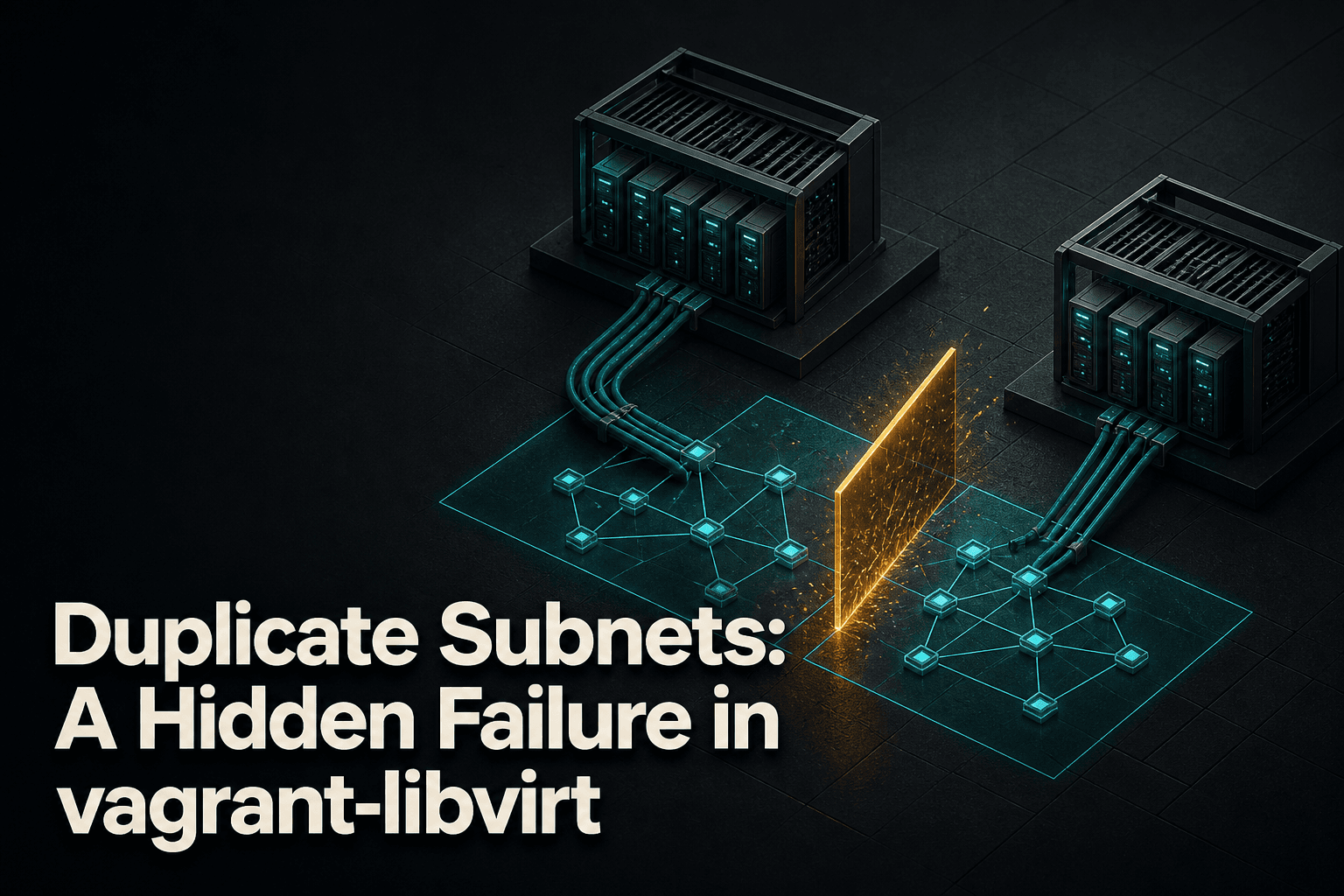
Virtualized network labs can fail for reasons that initially look unrelated to addressing. In this case, vagrant-libvirt crashed when a pre-existing libvirt network used the same IP subnet as the management network that automation was trying to create under a different name.
Why Network Names Are Not Enough
The conflict occurred even though the existing and requested virtual networks had different libvirt names. Their overlapping IP subnets were the real problem, showing why object-name checks alone cannot establish that a new virtual network is safe to create.
This can make troubleshooting unnecessarily difficult. A mysterious plugin failure may send an operator toward virtual-machine definitions, host configuration or automation logic when the underlying issue is simply duplicate address space.
Add Subnet Checks Before Deployment
A practical preflight process should compare the requested management subnet with every virtual network already present on the host. This is especially important on systems shared by reusable network labs, standalone test machines and other automated environments.
- Inventory existing virtual networks before provisioning a new lab.
- Compare IP subnets, not only network names.
- Assign a unique management subnet to each environment that could run concurrently.
- Treat unexpected provisioning crashes as a reason to inspect address overlap early.
- Remove or change a conflicting network only after confirming that it is not required by another active workload.
Make Addressing Part of Automation Design
Repeatable automation depends on repeatable addressing. Lab templates should either reserve known non-overlapping ranges or perform a validation step that stops deployment with a clear conflict message before virtual machines are started.
The broader lesson applies beyond this particular plugin: infrastructure automation should validate the resources represented by an object, rather than assuming a unique object name means the underlying network is unique.
How ConnectMyAssets Helps
ConnectMyAssets does not manage libvirt virtual networks, but its IPAM module helps infrastructure teams document and coordinate address space used across managed network environments. That makes it easier to reserve lab ranges and avoid reusing subnets already assigned elsewhere.
For the network devices inside automated labs, ConnectMyAssets also provides relevant operational controls:
- Dynamic CMDB discovers managed devices and builds LLDP-based topology.
- Automation & ZTP supports repeatable deployment and zero-touch provisioning of supported network gear.
- Backup & History versions device configurations with SHA256 verification and one-click rollback.
- Credential Vault centralizes the credentials used to access managed infrastructure.
Together, these modules help teams keep addressing, device inventory and configuration changes visible while lab automation evolves.
Source: ipSpace.net