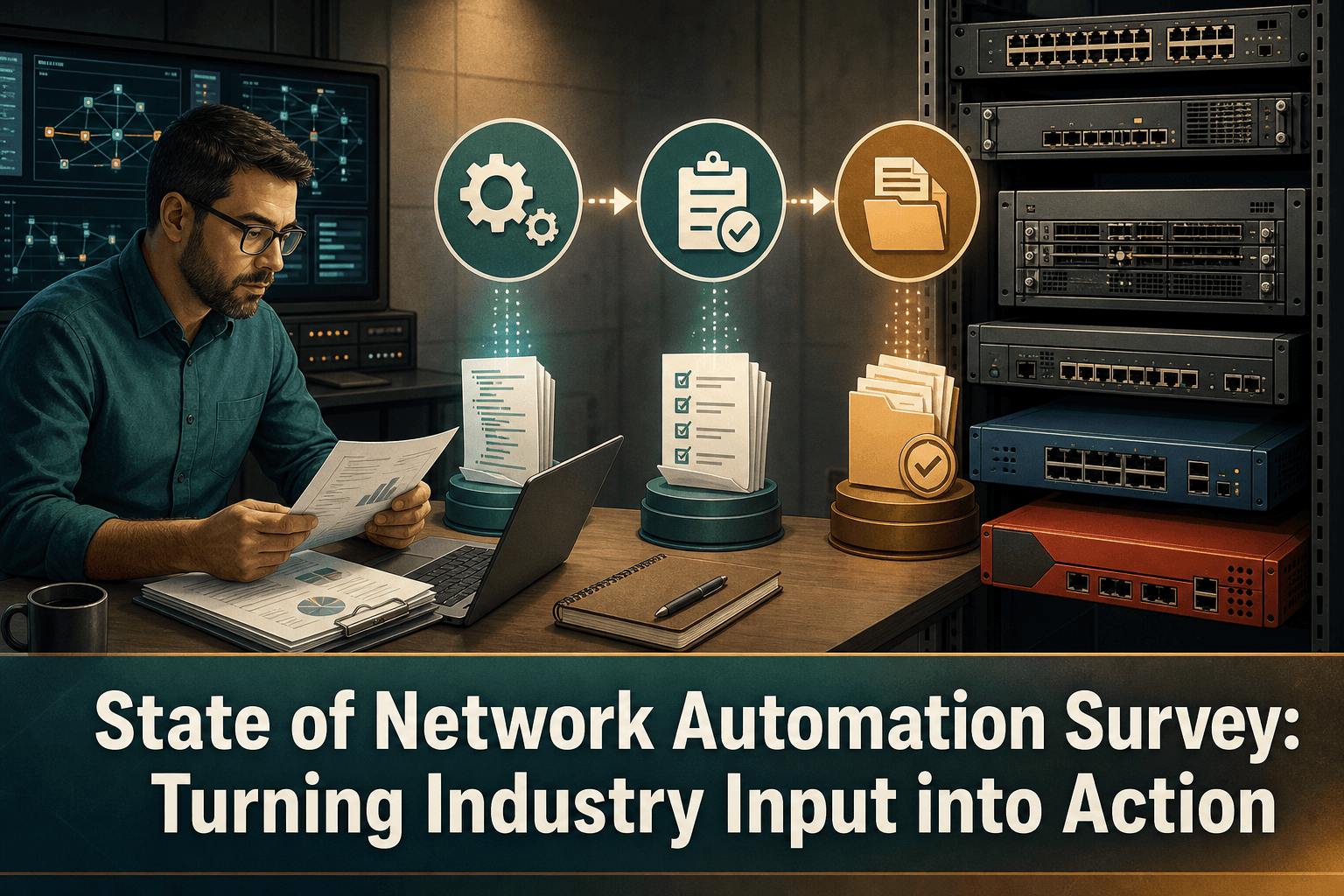
The Network Automation Forum is running its annual State of Network Automation Survey and is inviting anyone involved in network automation to participate. The announcement also points readers to the 2025 results for background.
The survey matters because automation is not simply a question of whether a team uses scripts. In a multi-vendor environment, progress also depends on how changes are validated, how exceptions are handled, and whether teams can produce reliable evidence of what happened.
If you work with network automation in any capacity, the Network Automation Forum is asking you to take a few minutes to complete the survey.
Three Areas Worth Examining
The source announcement does not reproduce the survey findings, so conclusions should come from the published results rather than assumptions. Nevertheless, the survey is a timely reason for infrastructure teams to review three practical areas internally.
1. Automation priorities
Automation should begin with workflows that are frequent, repeatable, and sufficiently understood. Useful questions include:
Which operational tasks consume the most engineering time?
Which changes follow a stable and documented process?
Where does vendor diversity create manual handoffs or inconsistent outcomes?
Which workflows need approval before execution?
Can the team stop or reverse a failed change safely?
This separates automation that reduces operational friction from automation adopted only because a tool supports it.
2. Validation before and after change
Executing a command is not the same as completing a successful change. Teams need criteria for establishing whether the intended state was reached without introducing an unwanted side effect.
A practical validation workflow can include:
Capture the current configuration and relevant asset state.
Check the proposed change against internal policy.
Execute through a controlled process.
Collect the resulting configuration.
Compare before and after states.
Record the outcome and retain rollback material.
The exact checks will vary by device and use case. What matters is that validation is designed into the workflow rather than left to an informal visual inspection.
3. Evidence collection
Automation can accelerate changes, but it can also accelerate gaps in documentation. Every automated workflow should answer basic questions:
Which asset was changed?
What configuration changed?
When did it happen?
Which workflow or operator initiated it?
Was the result validated?
Is the previous state available for recovery?
Can the records support a compliance review?
Evidence collection is especially important when one workflow reaches equipment from multiple vendors. Without consistent records, teams can end up with different levels of traceability across the same network.
From Survey Results to an Internal Baseline
Industry survey results are most useful when compared with local operating reality. After reviewing the published findings, network teams can create a simple internal baseline:
List current automated workflows and their owners.
Identify the vendors and asset types covered by each workflow.
Document pre-change and post-change validation.
Verify that configuration history and rollback data are retained.
Record workflows that still depend on undocumented manual steps.
Prioritize gaps according to operational impact rather than novelty.
Repeating this exercise over time can reveal whether automation coverage is expanding while control and traceability improve with it.
How ConnectMyAssets Helps
ConnectMyAssets is an on-prem, vendor-agnostic platform for managing multi-vendor network infrastructure. It helps teams connect automation with the operational controls that should surround it.
Automation & ZTP supports controlled, repeatable network workflows and provisioning.
Backup & History provides configuration versioning and one-click rollback, helping teams retain before-and-after states.
Dynamic CMDB maintains asset context so workflows and evidence can be associated with the relevant infrastructure.
Compliance Engine checks infrastructure against requirements including NIS2, ISO 27001, PCI, CISA, and NIST policies.
Credential Vault helps centralize the credentials required for managed operations.
Per-asset CVE Tracking and End-of-Life Tracking add vulnerability and lifecycle context when prioritizing automation work.
AI Insights, running locally, can assist analysis without requiring infrastructure data to leave the environment.
The objective is not automation for its own sake. It is repeatable change with configuration history, validation context, rollback readiness, and evidence that can be reviewed later.
Participate and Compare
Network engineers, architects, operators, developers, and others involved in automation can contribute through the survey link in the original announcement. Teams can also review the linked 2025 results and use them as a starting point for an internal discussion about priorities and gaps.
Source: ipSpace.net