What CERT-FR Has Reported
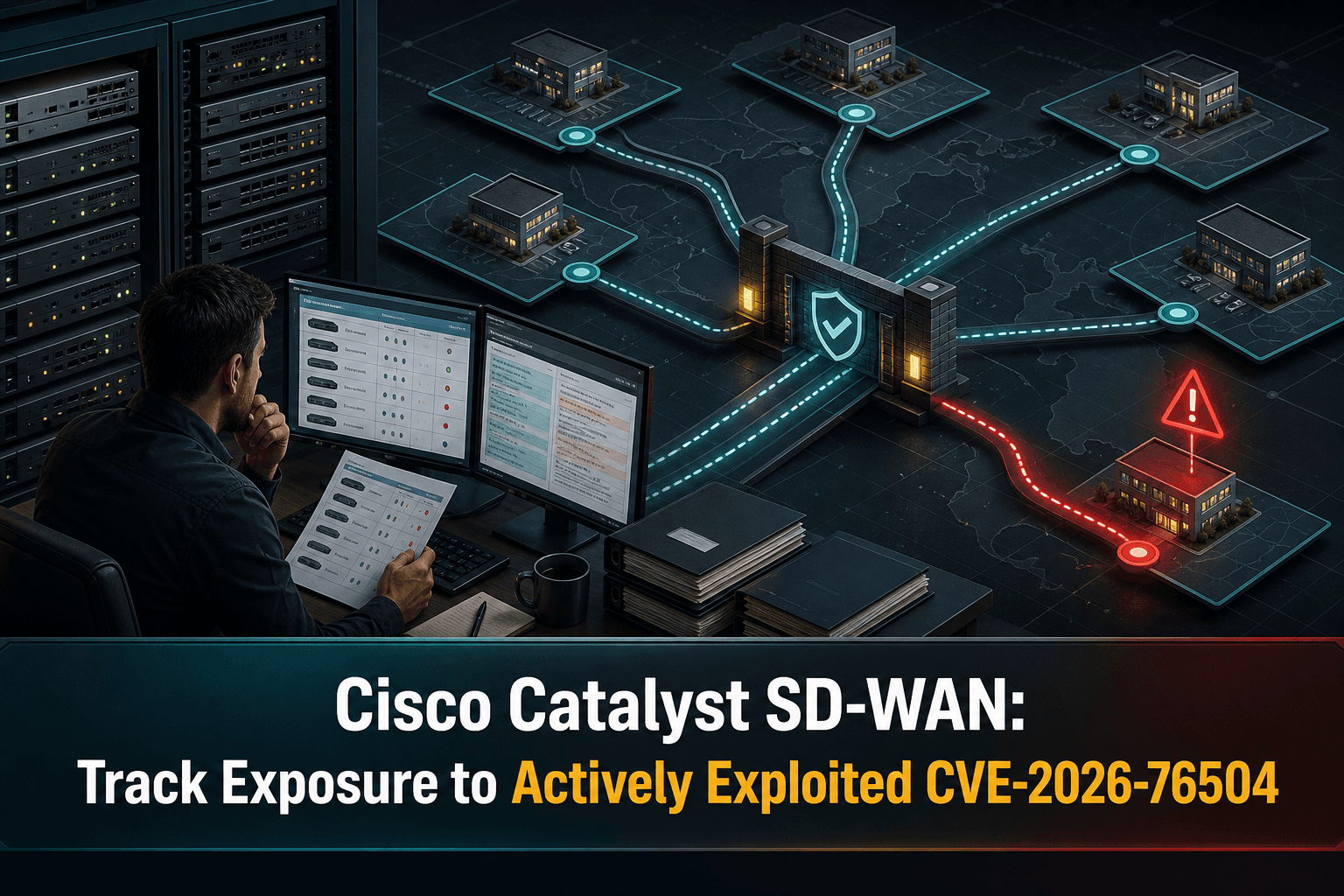
On October 1, 2026, CERT-FR published an advisory concerning CVE-2026-76504 in Cisco Catalyst SD-WAN. According to the notice, the vulnerability can allow an attacker to cause a security-policy bypass. Cisco has indicated that it is being actively exploited.
The supplied notice summary does not specify affected version ranges, exploitation prerequisites, or the exact remediation procedure. Teams should therefore use the official advisory as the authoritative reference rather than inferring applicability from the product name or CVE identifier alone.
Active exploitation raises the priority, but it does not remove the need for precise scoping. Confirm each asset, its role, and its installed version before recording it as affected or remediated.
Immediate Operational Priorities
1. Establish the Catalyst SD-WAN inventory
Identify every Cisco Catalyst SD-WAN component in the environment, including systems operated at branches, data centers, and recovery sites. For each asset, record:
Hostname and asset owner
Location and operational role
Hardware or virtual-appliance identity
Installed software version
Management address and known exposure
Business service or site supported
Current lifecycle and support status
Include standby, laboratory, and disaster-recovery systems. Assets outside the main production path can still create gaps in the investigation if they are omitted from the inventory.
2. Verify applicability against authoritative guidance
Compare the recorded product and version information with the affected scope published through the official Cisco and CERT-FR guidance. Do not assume that every Catalyst SD-WAN asset is vulnerable, and do not close an asset merely because its name differs slightly from wording in the advisory.
Where version data is missing or stale, collect it directly from the device through an approved administrative path. Record the collection time so reviewers can distinguish current evidence from historical inventory data.
3. Prioritize by exposure and operational importance
Once applicability is established, organize the response around practical risk factors:
Whether the component falls within the affected scope
Its network reachability and administrative exposure
The criticality of the sites or services it supports
Available maintenance windows
Dependencies that could affect remediation or validation
The source summary does not describe the exploitation path. Avoid assuming that a particular topology, interface, or access condition makes a system safe unless authoritative guidance confirms it.
4. Preserve configurations before change
Capture a current configuration backup before applying vendor-directed remediation or related configuration changes. This creates a known baseline for comparison and supports recovery if a configuration change causes an operational problem.
Configuration rollback should not be confused with software-image rollback. Any software change must follow the applicable vendor guidance and the organization’s tested change procedure.
5. Validate and retain evidence
After remediation, verify each asset again and retain evidence that shows:
The asset that was reviewed
Its version before the change
The approved remediation action
The time and result of the change
Its version and configuration state afterward
The validation outcome
Any exception, postponement, or failed change
This evidence helps security, network, audit, and management teams work from the same status rather than relying on spreadsheets or unverified completion messages.
How ConnectMyAssets Helps
ConnectMyAssets provides an on-premises, vendor-agnostic workflow for turning this advisory into a controlled infrastructure response:
Dynamic CMDB: identify Cisco Catalyst SD-WAN assets, owners, locations, roles, versions, and service relationships in one current inventory.
Per-Asset CVE Tracking: associate CVE-2026-76504 with the assets under review and track whether each device is applicable, pending validation, remediated, or covered by an exception.
Backup & History: preserve configuration versions before and after changes, compare them, and use one-click configuration rollback when appropriate.
Automation & ZTP: run approved, staged inventory or validation tasks across selected assets instead of relying on repetitive manual collection.
Compliance Engine: retain remediation records and map evidence to internal controls or frameworks such as NIS2, ISO 27001, PCI, CISA, and NIST where relevant.
Credential Vault and SSH Bastion: centralize approved administrative access and provide a controlled route for collecting version and configuration evidence.
End-of-Life Tracking: flag affected assets whose lifecycle status may complicate remediation or require a replacement decision.
ConnectMyAssets does not replace Cisco’s vulnerability guidance. It helps teams establish which managed assets are in scope, preserve change history, execute approved operational steps, and demonstrate what was verified and remediated.
A Defensible Response Checklist
Register the CERT-FR advisory and CVE-2026-76504 in the incident or vulnerability workflow.
Produce a complete Catalyst SD-WAN asset list.
Refresh missing or outdated version information.
Compare each asset with authoritative affected-product guidance.
Prioritize confirmed exposure according to reachability and business impact.
Back up configurations before approved changes.
Apply the applicable vendor-directed remediation through change control.
Recheck versions and configuration state after the change.
Record exceptions and compensating decisions with owners and review dates.
Retain before-and-after evidence for operational and compliance review.
Source: CERT-FR