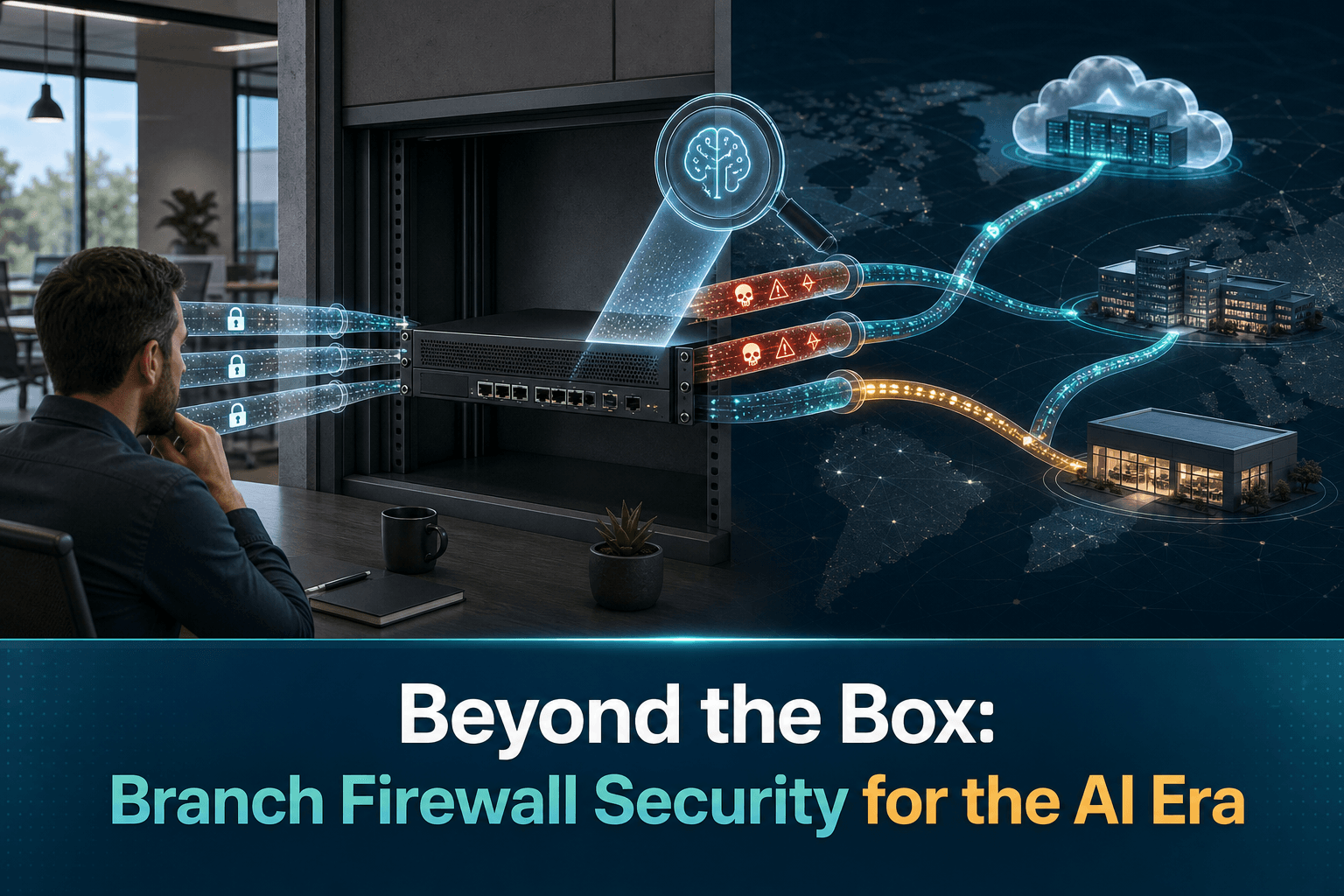
A Broader Role for the Branch Firewall
The branch firewall is no longer responsible only for enforcing rules at the network perimeter. Branches must handle encrypted application traffic, evolving threats, distributed connectivity, and day-to-day operational demands—often with limited local IT resources.
Cisco presents the Secure Firewall 200 Series as a response to that environment. Its stated focus combines four areas:
AI-powered threat detection to help identify malicious activity.
Encrypted visibility for security analysis when traffic is protected by encryption.
SD-WAN capabilities supporting branch connectivity.
Simpler firewall operations for distributed environments.
This convergence matters because security and connectivity decisions at a branch increasingly affect one another. A firewall policy change can influence application access, while a routing or WAN change can alter the path through which controls are applied.
AI-Assisted Detection at the Branch
AI-assisted detection is intended to help security systems recognize suspicious behavior and emerging attack patterns. In a branch context, that can strengthen the firewall’s role as a local enforcement point while reducing reliance on purely static indicators.
The source describes AI-powered threat detection as a key capability of the Secure Firewall 200 Series. It does not, however, remove the need for operational controls around the appliance. Teams still need to know:
Which assets are deployed at each site.
Which configuration is currently active.
What changed, when it changed, and whether the change was authorized.
Whether known vulnerabilities affect a particular asset.
Whether policies remain aligned with internal and regulatory requirements.
AI detection and infrastructure governance therefore address different parts of the same problem: the firewall identifies and blocks threats, while disciplined management helps ensure that the control itself remains correctly configured and maintained.
Visibility When Traffic Is Encrypted
Encryption protects data in transit, but it can also make malicious activity harder for network controls to assess. Cisco highlights encrypted visibility as part of its approach to modern branch protection.
For network teams, the operational question is not simply whether visibility exists. Deployment planning should also consider where security controls are applied, which traffic is covered by policy, and how configuration changes are documented. These decisions should be validated against the organization’s own security, privacy, and performance requirements.
Bringing Security and SD-WAN Together
Including SD-WAN in a branch firewall platform reflects the increasing overlap between secure access and WAN operations. Combining these functions can help a branch apply connectivity and security decisions at the same enforcement point.
Infrastructure teams should nevertheless retain a clear operational record across both domains. Useful questions include:
Which branch firewall owns each connection and policy?
Is the deployed configuration backed up and versioned?
Are equivalent controls applied consistently across sites?
Can operators identify drift from an approved baseline?
Is the hardware’s vulnerability and lifecycle status known?
These checks become particularly important in multi-vendor estates, where different branches may use different platforms or generations of equipment.
Simpler Operations Need Verifiable Controls
Operational simplicity is valuable, but it should not mean losing visibility into change history or compliance status. A sound branch-firewall process should connect deployment, configuration governance, vulnerability monitoring, and lifecycle planning.
That means treating each firewall as a managed infrastructure asset rather than an isolated security box. Inventory data, configuration history, compliance evidence, credentials, topology, vulnerabilities, and end-of-life information all contribute to operational resilience.
Where ConnectMyAssets Fits
The Cisco Secure Firewall 200 Series provides vendor-specific security and connectivity capabilities at the branch. ConnectMyAssets complements that innovation with an on-prem, vendor-agnostic management layer for the broader infrastructure estate.
Relevant ConnectMyAssets modules include:
Dynamic CMDB to inventory branch firewalls and associate them with sites and other infrastructure assets.
Backup & History to version configurations, review changes, and support one-click rollback when a known configuration must be restored.
Firewall Management to support consistent operations across multi-vendor firewall environments.
Compliance Engine to assess infrastructure against policies associated with NIS2, ISO 27001, PCI, CISA, and NIST requirements.
Per-asset CVE Tracking to connect vulnerability information to the specific devices deployed in the network.
End-of-Life Tracking to identify equipment approaching lifecycle milestones and support replacement planning.
Automation & ZTP to standardize repeatable deployment and configuration tasks across branches.
Credential Vault to protect the administrative credentials used to access managed infrastructure.
ConnectMyAssets does not replace the firewall’s native threat-detection capabilities. It helps infrastructure and security teams maintain the inventory, configuration evidence, compliance posture, and lifecycle context needed to operate branch security consistently—especially when the estate includes products from several vendors.
The Operational Takeaway
Cisco’s Secure Firewall 200 Series reflects how the branch firewall is evolving beyond basic perimeter filtering. AI-powered detection, encrypted visibility, SD-WAN, and simplified operations bring security and connectivity closer together.
The long-term value of those capabilities depends on operational discipline around them. Accurate inventory, recoverable configurations, vulnerability tracking, compliance checks, and lifecycle planning remain essential if branch security is to stay reliable as the network changes.
Source: Cisco