Arista is positioning standard Ethernet as an alternative to proprietary AI interconnect stacks, including Nvidia’s NVLink and InfiniBand technologies. Its latest move combines new reference architectures with integrations involving AMD, Arm, Broadcom, Meta, Microsoft, Qualcomm, and other industry participants.
The announcement is significant for network engineers because it expands the operational scope of an AI fabric. The network is no longer just a collection of switches and links: it is part of a tightly integrated system involving accelerators, optics, rack design, power delivery, liquid cooling, and software from multiple vendors.
Ethernet for Scale-Up and Scale-Out
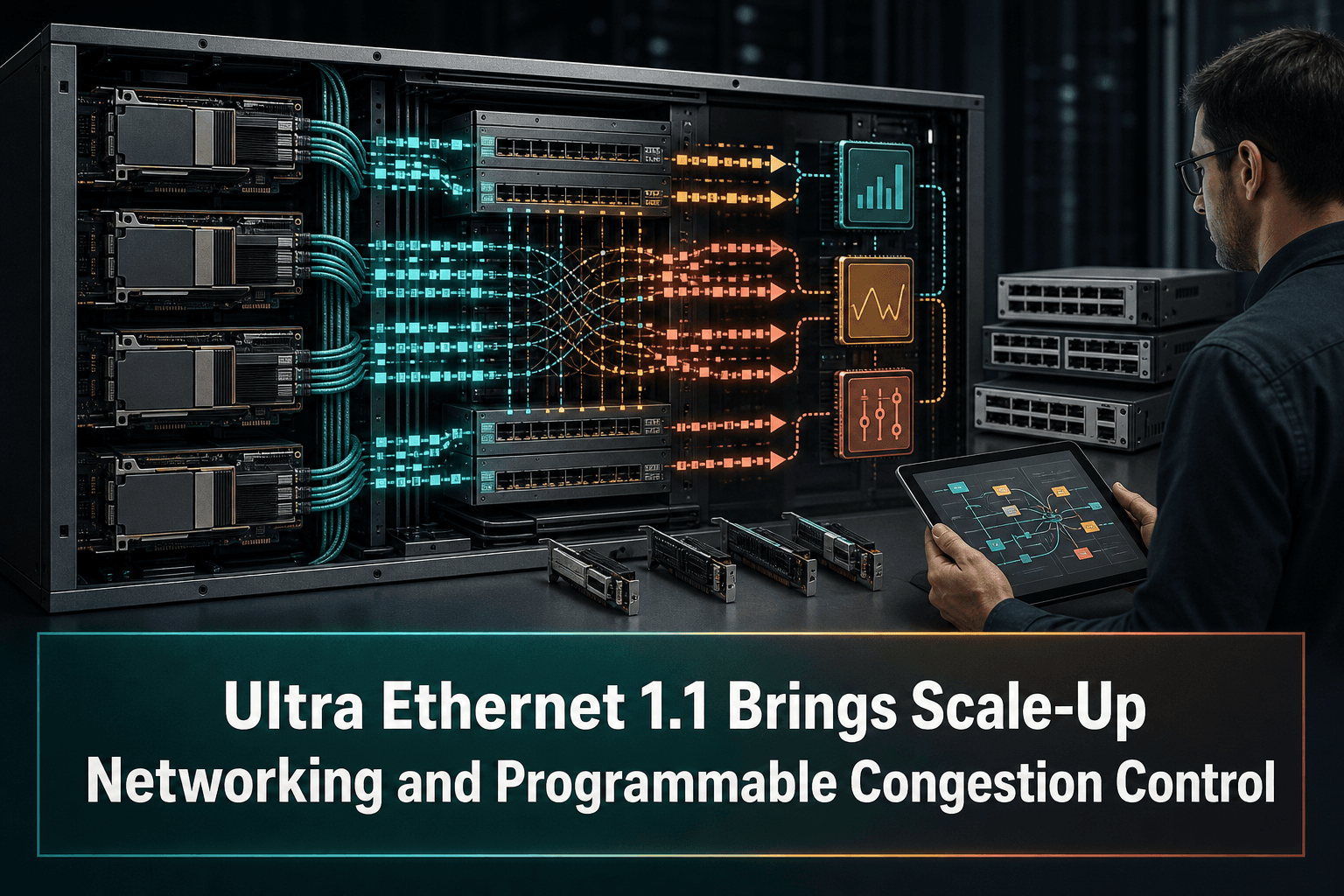
Arista describes its approach as ESUN Ethernet for scale-up and Ethernet with Ultra Ethernet Consortium features for scale-out.
The Ethernet for Scale-Up Networking initiative, or ESUN, was formed by the nonprofit Open Compute Project. Its goal is to advance Ethernet for connectivity inside accelerated AI infrastructure while retaining the bandwidth, latency, reliability, and in-order delivery needed for collective communication.
ESUN participants cited in the announcement include AMD, Arista, Arm, Broadcom, Cisco, HPE Networking, Marvell, Meta, Microsoft, Nvidia, OpenAI, and Oracle. The initiative is intended to preserve flexibility across:
Accelerators
Switching silicon
Optics
Physical rack designs
Network software
The Ultra Ethernet Consortium has a related but broader objective: developing a complete Ethernet-based communication stack for high-performance networking. Its members include AMD, Arista, Broadcom, Cisco, Eviden, HPE, Intel, Meta, and Microsoft.
What the Reference Architectures Contain
Arista plans to offer its 7060EX7 Series switches alongside fiber patch panels, liquid-cooling manifolds, drip trays with active leak detection, rack management controllers, and power shelves equipped with backup battery units. These elements will be combined with software and technologies from partner vendors.
The company outlined three Etherlink SU-144 designs based on ESUN:
Orthogonal chassis
This design uses direct orthogonal connections between accelerator and switch blades. It supports a density of 144 XPUs within direct liquid-cooling envelopes ranging from 100 kW to 400 kW.
Cabled backplane
A high-density cabled backplane is combined with a modular rack structure. The objective is a design that remains serviceable despite its density.
Cross-rack architecture
This modular model distributes compute and networking across multiple racks, allowing larger scale-up and scale-out domains. Analyst Bob Laliberte highlighted its ability to extend the scale-up domain beyond one rack and support as many as 1,024 accelerators while maintaining high-bandwidth, low-latency connectivity.
The Operational Challenge: Proving the Fabric
An open, multi-vendor architecture creates choice, but shared Ethernet foundations do not eliminate the need for operational validation. Engineers still need an authoritative record of which components are installed, how they are connected, and which configurations were validated together.
A practical deployment process should include:
Inventory every managed network component. Record switches, software context, interfaces, optics, rack position, and relevant accelerator-facing connections.
Map dependencies. Document how network devices relate to patch panels, rack controllers, power systems, and cooling infrastructure, even when some of those elements are maintained by separate teams.
Define approved combinations. Preserve the vendor, hardware, software, optic, and topology combinations that passed qualification testing.
Capture configuration baselines. Store the known-good configuration before fabric expansion, maintenance, or interoperability testing.
Validate changes in stages. Treat firmware, switch configuration, optics, cabling, and rack changes as potentially connected rather than isolated events.
Document test evidence. Associate acceptance results and operational notes with the assets and links involved.
Track lifecycle and security exposure. Monitor affected assets for disclosed vulnerabilities and end-of-life milestones without assuming that every component follows the same support cycle.
This discipline becomes especially important in cross-rack designs, where a physical or configuration change can affect a larger scaling domain.
Where ConnectMyAssets Fits
ConnectMyAssets provides an on-prem, vendor-agnostic operational layer for managing the network infrastructure inside a multi-vendor AI fabric.
The Dynamic CMDB inventories managed network assets and maintains their relationships, giving engineers a current record of the deployed fabric.
Topology helps document switch and link dependencies across racks instead of relying on static diagrams alone.
Backup & History versions device configurations and provides one-click rollback to a known state after an unsuccessful change.
The Automation & ZTP module supports repeatable configuration workflows, reducing drift when similar fabric elements are deployed at scale.
Per-asset CVE Tracking connects disclosed vulnerabilities to the individual assets that may require investigation.
End-of-Life Tracking helps teams identify infrastructure approaching vendor support milestones.
The Compliance Engine evaluates managed infrastructure against policies aligned with NIS2, ISO 27001, PCI, CISA, and NIST requirements.
The Credential Vault and SSH Bastion centralize controlled administrative access without moving infrastructure management to a vendor cloud.
ConnectMyAssets does not determine whether a specific accelerator, optic, switch, or cooling design is interoperable. It helps engineering teams preserve the inventory, configurations, evidence, and change history needed to validate and operate those combinations responsibly.
A Broader Role for Ethernet Operations
Arista’s strategy reflects a growing effort to make Ethernet serve both scale-up and scale-out AI environments. If these architectures gain adoption, network teams will manage increasingly dense systems that cross traditional boundaries between networking, compute, facilities, and platform engineering.
The standards may be Ethernet-based, but successful operation will still depend on disciplined inventory, qualification, configuration control, automation, and documentation across every participating vendor.
Source: Network World