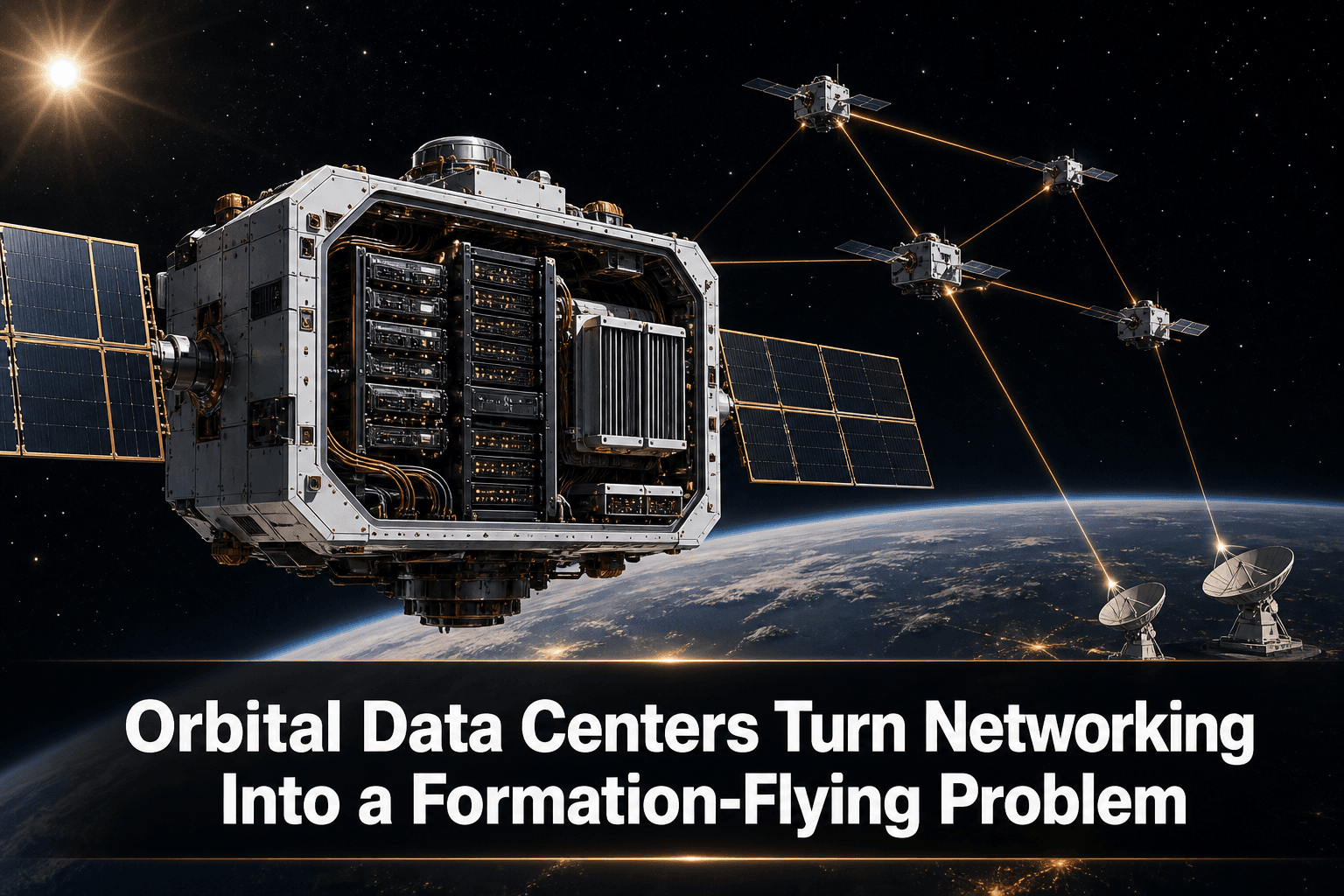
Google has launched what The Register describes as its first data-center satellite, accompanied by research indicating that orbiting “bit barns” can be technically viable. The report also makes the scale of the idea clear: broader deployment depends on demanding assumptions, including a scenario in which SpaceX can launch 1,800 Starships and researchers solve difficult networking, design, and formation-flying problems.
That distinction matters. A satellite carrying compute hardware is one milestone; operating many orbital systems as coherent infrastructure is a much larger networking and management challenge.
Networking Beyond the Ground
In a terrestrial data center, engineers can physically inspect equipment, replace failed components, trace cables, and reach management interfaces through established operational paths. Orbital infrastructure changes those assumptions.
The network must account for assets whose relative positions may matter, links that cannot be treated like fixed building cabling, and systems that have to remain manageable at a distance. This elevates several familiar infrastructure concerns:
Topology awareness: Operators need an accurate view of which assets and links constitute the service at any given time.
Synchronization: Distributed computing depends on coordinated systems, but orbital movement makes coordination part of the physical design problem.
Configuration consistency: A fleet cannot be operated reliably if nodes drift into undocumented or incompatible states.
Remote recovery: When physical intervention is impractical, rollback and controlled automation become core operational capabilities rather than conveniences.
Lifecycle visibility: Every deployed asset must be tracked from introduction through maintenance and eventual retirement.
The source does not present these issues as solved at fleet scale. Instead, networking, design, and formation flying are among the difficult areas researchers still need to address.
Topology Becomes Dynamic by Design
For conventional infrastructure, topology changes are often caused by maintenance, expansion, failure, or configuration work. In an orbital environment, motion and formation are inherent to the architecture.
This creates an important operational question: is the topology model merely a diagram of intended connections, or does it reflect the infrastructure’s current state? A useful operational model would need to distinguish between:
The intended formation and service design
The assets currently available
The links expected to exist
Deviations caused by faults or configuration changes
The dependencies that determine whether compute capacity remains usable
The lesson is relevant even before orbital data centers become commonplace. Any distributed network with changing links or remote sites benefits from treating topology as live operational data rather than static documentation.
Synchronization Is More Than a Software Detail
The Register’s report highlights synchronization as one of the hard problems. In an orbital architecture, coordination spans compute workloads, network state, configuration, and spacecraft formation.
This means synchronization cannot be reduced to a single mechanism. Operators would need clear answers to broader questions:
Which system holds the authoritative state?
How are delayed, unavailable, or inconsistent nodes handled?
What happens when a configuration change reaches only part of the fleet?
How is a failed rollout identified and reversed remotely?
How are actual asset states reconciled with the intended design?
These are recognizable network-management questions, but the consequences of ambiguity increase when equipment is physically inaccessible.
Remote Operations Must Assume No Hands-On Fix
Orbital data centers intensify a principle that already applies to remote terrestrial infrastructure: changes must be observable, reproducible, and reversible.
A sound operational approach would prioritize:
Documented baselines before changes
Versioned configurations and auditable history
Staged automation rather than uncontrolled fleet-wide changes
Validation after each remote action
Recovery procedures that do not depend on local physical access
Accurate inventories linked to configuration and lifecycle status
These are not claims about the specific controls used by Google’s research satellite. They are the operational implications of managing distributed infrastructure where hands-on intervention is exceptionally difficult.
Where ConnectMyAssets Fits
ConnectMyAssets is an on-prem, vendor-agnostic platform for managing multi-vendor network infrastructure. It is not a spacecraft-control system, but the operational disciplines raised by orbital computing closely match challenges already faced in large, distributed terrestrial networks.
Relevant ConnectMyAssets capabilities include:
Dynamic CMDB and Topology: Maintain an up-to-date model of managed assets, their relationships, and network dependencies.
Backup & History: Preserve configuration versions, inspect changes, and use one-click rollback when a supported device configuration must be restored.
Automation & ZTP: Apply repeatable workflows to distributed infrastructure while reducing manual configuration variance.
Compliance Engine: Evaluate managed infrastructure against policies related to NIS2, ISO 27001, PCI, CISA, and NIST requirements.
Per-asset CVE Tracking: Associate known vulnerability information with the assets under management.
End-of-Life Tracking: Identify lifecycle risk before unsupported equipment becomes an operational liability.
SSH Bastion and Credential Vault: Centralize controlled administrative access and protect infrastructure credentials.
The practical takeaway is terrestrial but important: before organizations can manage infrastructure in extreme remote environments, they need reliable inventory, topology, configuration history, policy validation, and rollback across the networks they operate today.
Source: The Register