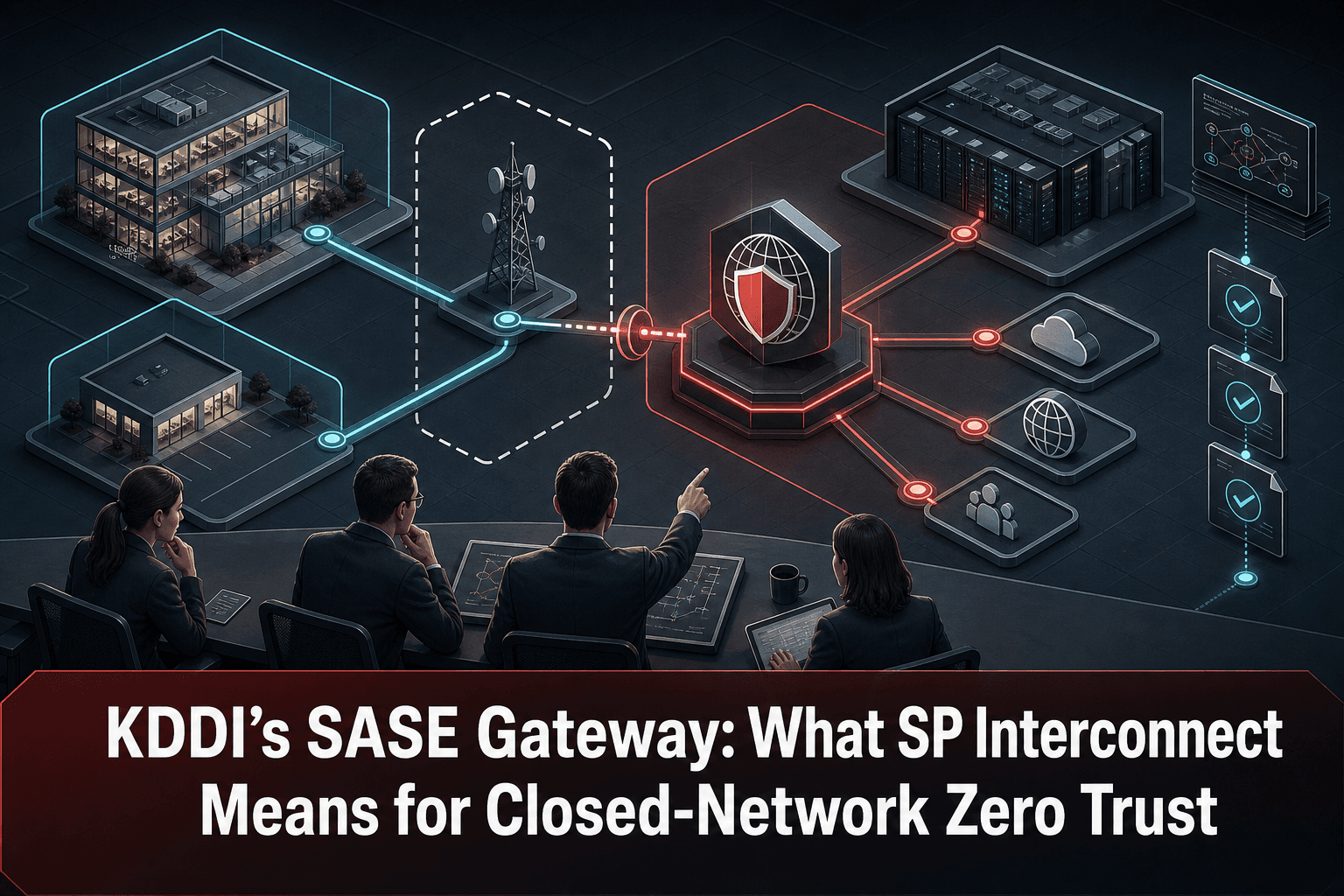
KDDI Corporation has announced a SASE Gateway offering in partnership with Palo Alto Networks. KDDI is described as a long-standing NextWave partner and Managed Security Service Provider (MSSP) with an established relationship with the security vendor.
Beyond the announcement itself, the design raises an important infrastructure question: what changes when a service-provider interconnect becomes part of the path between private networks and zero-trust security controls?
The source summary does not provide detailed topology, protocol, version, or policy information. Network teams should therefore evaluate the implementation from their own architecture and operational requirements rather than assume specific technical capabilities.
Why the Interconnect Matters
A closed or private network does not become zero trust merely because it avoids the public internet. The interconnect determines where traffic enters the security service, where policies can be enforced, and which organization is responsible for each part of the path.
A service-provider design can simplify connectivity by creating a defined handoff between the enterprise network, the carrier environment, and the SASE security layer. That can reduce the number of individually engineered paths, but it also makes the handoff a critical operational boundary.
Network teams should document:
Which sites, data centers, and network segments use the interconnect.
Where routes are exchanged and which prefixes are permitted.
Where security inspection begins and ends.
Which controls remain on enterprise firewalls, routers, or other infrastructure.
How redundancy and failover affect the inspection path.
Who owns configuration changes and incident escalation at each boundary.
Segmentation Must Survive the Journey
Segmentation is not only a firewall-rule question. It also depends on routing, addressing, policy attachment, and the way traffic is handed from one administrative domain to another.
A SASE gateway design should therefore be assessed end to end. If two enterprise zones are meant to remain isolated, the intended separation must still be enforceable after traffic enters the provider interconnect. Route propagation, overlapping address space, default paths, and failover behavior can all affect the result.
A practical review should start with three questions:
What is the source segment? Record the site, subnet, asset group, and business purpose.
What path can it take? Include normal, backup, and incident-driven paths.
Where is access denied or allowed? Identify the responsible enforcement point and policy owner.
This approach helps distinguish architectural intent from the configuration that actually delivers it.
Zero Trust Requires More Than a Private Path
A private service-provider connection can offer a controlled transport path, but transport and trust are separate concerns. Network teams still need explicit policies governing which assets and segments may communicate.
Operationally, that means treating the SASE gateway as one enforcement point within a broader control system—not as proof that every connected network is inherently trusted or compliant.
Teams should preserve evidence showing:
The approved connectivity and segmentation design.
Current routing and firewall configurations around the interconnect.
The history of changes affecting permitted paths.
Periodic reviews of rules, objects, and network boundaries.
Exceptions, their owners, and their expiration or review dates.
Known vulnerabilities and end-of-life status for supporting assets.
Operational Evidence Is Part of the Architecture
Provider interconnects introduce a shared-responsibility boundary. During an audit or incident, a diagram alone will not show whether the environment still matches the approved design.
Useful evidence includes configuration snapshots, change history, asset ownership, IP assignments, firewall-rule reviews, topology records, and records of remediation. Keeping this material synchronized is especially important in a multi-vendor estate where routers, firewalls, switches, and security services may have different operational workflows.
A simplified path is only operationally simpler when teams can identify its assets, reconstruct its changes, and verify its controls.
Where ConnectMyAssets Fits
ConnectMyAssets does not replace the SASE service. Its role is to manage and document the surrounding multi-vendor network infrastructure from an on-prem platform.
Relevant modules include:
Dynamic CMDB and Topology: Inventory the routers, firewalls, switches, interfaces, and network relationships around the provider handoff.
Backup & History: Preserve configuration versions, compare changes, and provide one-click rollback for supported managed infrastructure.
Firewall Management: Maintain visibility into the firewall policies and objects that complement gateway enforcement.
IPAM: Document subnets and address assignments involved in segmentation and route exchange.
Compliance Engine: Collect operational evidence and assess infrastructure controls against frameworks such as NIS2, ISO 27001, PCI, CISA, and NIST.
Per-asset CVE Tracking and End-of-Life Tracking: Identify lifecycle and vulnerability risks in the equipment supporting the interconnect.
Automation & ZTP: Apply repeatable configuration processes to reduce drift across connected sites.
Credential Vault and SSH Bastion: Control administrative access to the infrastructure under the network team’s responsibility.
Because ConnectMyAssets is vendor-agnostic and on-prem, it can provide a consistent infrastructure record without turning a provider-specific service interface into the network team’s system of record.
Questions for Network Teams
Before adopting or extending a provider-interconnected SASE design, ask:
Is every participating network segment represented in the CMDB?
Can the team reconstruct the configuration before and after a change?
Are normal and failover paths both documented?
Is ownership clear at the enterprise, provider, and security-service boundaries?
Can auditors see evidence that segmentation policies are reviewed and maintained?
Are the supporting assets monitored for CVEs and end-of-life milestones?
KDDI’s announcement illustrates how service-provider interconnects can become part of a closed-network zero-trust strategy. The lasting operational benefit, however, depends on maintaining accurate inventory, controlled configurations, resilient segmentation, and verifiable evidence around that interconnect.
Source: Palo Alto Networks