The Network Becomes Part of the Training System
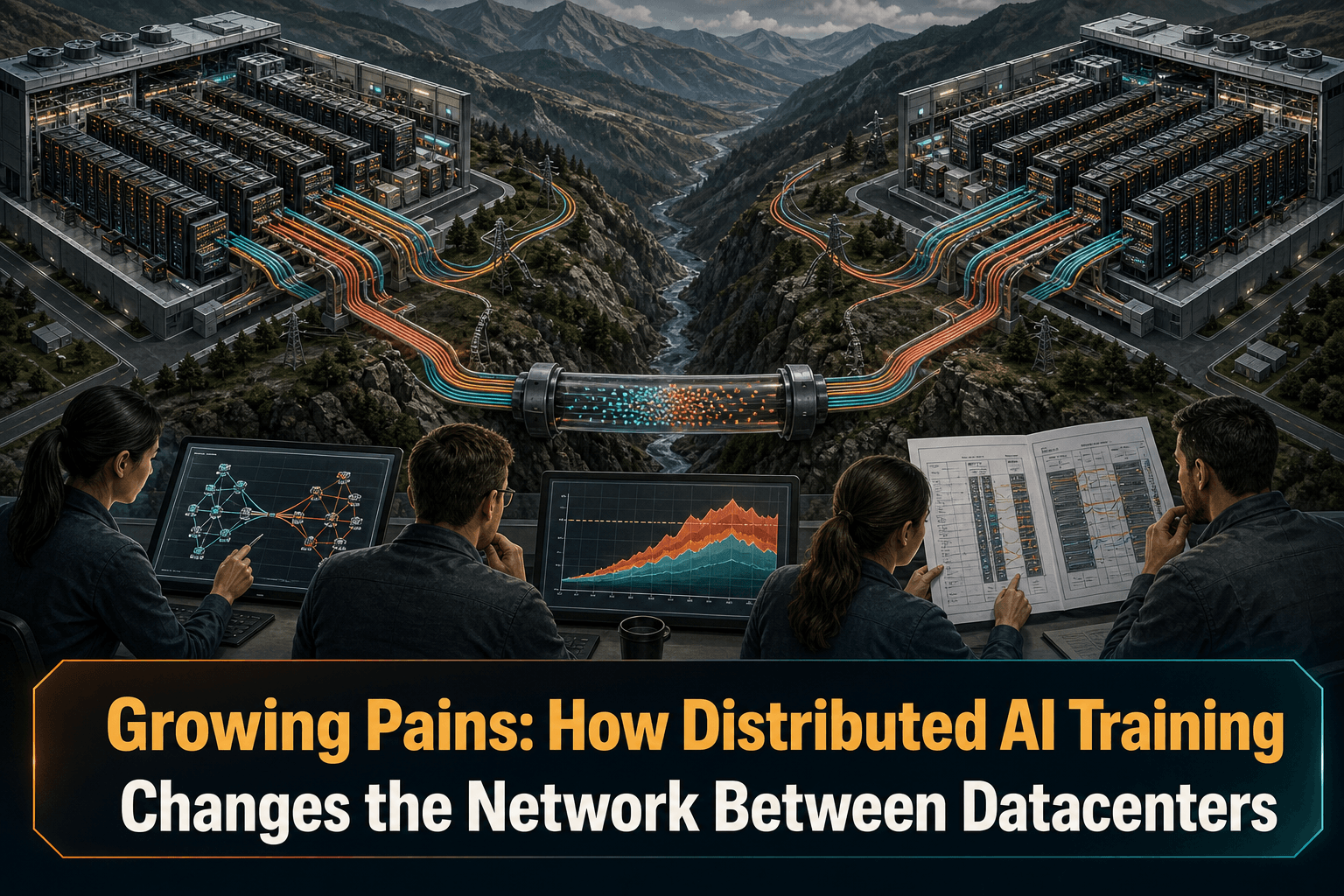
Connecting GPUs inside one datacenter is already difficult. As the sponsored feature from The Register observes, coordinating thousands of GPUs efficiently across hundreds of kilometers introduces another set of challenges.
The inter-datacenter network is no longer merely carrying background replication or ordinary application traffic. For distributed training, its behavior can directly affect how effectively remote computing resources work together. Capacity, delay, and congestion therefore need to be considered as parts of the overall system rather than as isolated carrier or transport concerns.
A large pool of compute does not automatically behave like one efficient system when its resources are separated by long-distance links.
Bandwidth Must Be Evaluated End to End
Distributed training can create substantial demand between sites, but nominal link capacity does not tell the entire story. Planners need to understand how much usable capacity remains along the complete path and what happens when training traffic competes with other services.
Relevant planning questions include:
Which datacenters and network paths participate in the training environment?
How much inter-site capacity is available to the workload in practice?
Is that capacity shared with replication, backup, user, or production traffic?
Can simultaneous activity from many systems create concentrated demand?
Which link or device becomes the limiting point as the environment grows?
The important shift is from asking whether two sites are connected to asking whether the whole path can sustain the workload under realistic operating conditions.
Distance Makes Latency Harder to Ignore
Hundreds of kilometers of separation introduce delay that cannot be addressed simply by adding more nominal bandwidth. When remote GPU resources must coordinate repeatedly, latency can influence how efficiently the wider pool operates.
Network teams should consequently assess more than average reachability. They need evidence showing how paths behave over time and during periods of contention. A seemingly healthy connection may still be poorly matched to a workload that depends on frequent coordination across sites.
This makes workload placement a network design decision as well as a compute decision. Before distributing a training job, teams should establish what degree of inter-site coordination it requires and whether the selected path can support that pattern consistently.
Congestion Control Becomes a Shared-System Concern
When thousands of processing units participate in a distributed workload, simultaneous transfers can place unusual pressure on shared inter-datacenter paths. Congestion control is therefore not just a tuning exercise for an individual connection. It concerns how competing flows behave together and how the network responds when demand approaches available capacity.
An evidence-based review should examine:
Contention: what other workloads use the same links and devices.
Concentration: where multiple paths or flows converge.
Consistency: whether behavior changes materially during busy periods.
Recovery: how quickly useful throughput returns after congestion.
Fairness: whether one workload can impair other essential services.
Configuration consistency matters here. Different settings across the devices forming an inter-datacenter path can make troubleshooting more difficult, especially when the observed symptom appears only under load.
Replace Capacity Assumptions With Evidence
AI infrastructure can grow faster than traditional planning cycles. A defensible capacity plan should therefore connect workload expectations to an accurate record of the network that will carry them.
A practical process is to:
Establish an inventory of the participating sites, devices, interfaces, and paths.
Document the current topology and identify shared or concentrated links.
Preserve configuration baselines for the infrastructure along each path.
Measure workload behavior under representative conditions using the appropriate performance and workload tools.
Compare observed demand with available capacity and operational headroom.
Record changes and repeat the assessment as the GPU estate or training model evolves.
This approach helps separate several different questions: whether capacity exists, whether it is available to the workload, whether latency is acceptable, and whether congestion changes the result under realistic conditions.
How ConnectMyAssets Helps
ConnectMyAssets provides the infrastructure record needed to support evidence-based planning across a multi-vendor network.
Dynamic CMDB maintains an on-premises inventory of the devices and assets involved in inter-datacenter connectivity.
Topology documents how infrastructure is connected, helping teams identify dependencies and potential concentration points.
Backup & History preserves configuration versions so engineers can compare the network before and after a change or use one-click rollback when required.
Compliance Engine checks configurations against organizational requirements and supported security frameworks, reducing the risk that urgent capacity work bypasses established controls.
Automation & ZTP can apply approved changes consistently across supported infrastructure instead of relying on repetitive manual edits.
End-of-Life tracking highlights lifecycle risk in the network expected to support expanding AI workloads.
ConnectMyAssets complements, rather than replaces, performance telemetry and workload benchmarking. Those tools show how traffic behaves; ConnectMyAssets supplies the asset, topology, configuration-history, compliance, and lifecycle evidence needed to understand what infrastructure produced that behavior and how it changed.
Plan the Network and Compute Together
Distributed AI training turns the connection between datacenters into an active component of the compute architecture. Bandwidth remains important, but it must be considered alongside distance, latency, contention, configuration consistency, and the behavior of shared paths.
The most reliable response is not to guess at a capacity multiplier. It is to maintain an accurate infrastructure baseline, test representative workloads, preserve the resulting evidence, and reassess the network whenever the compute estate or topology changes.
This article discusses a sponsored feature published by The Register.
Source: The Register