From Point-to-Point Experiments to a Shared Fabric
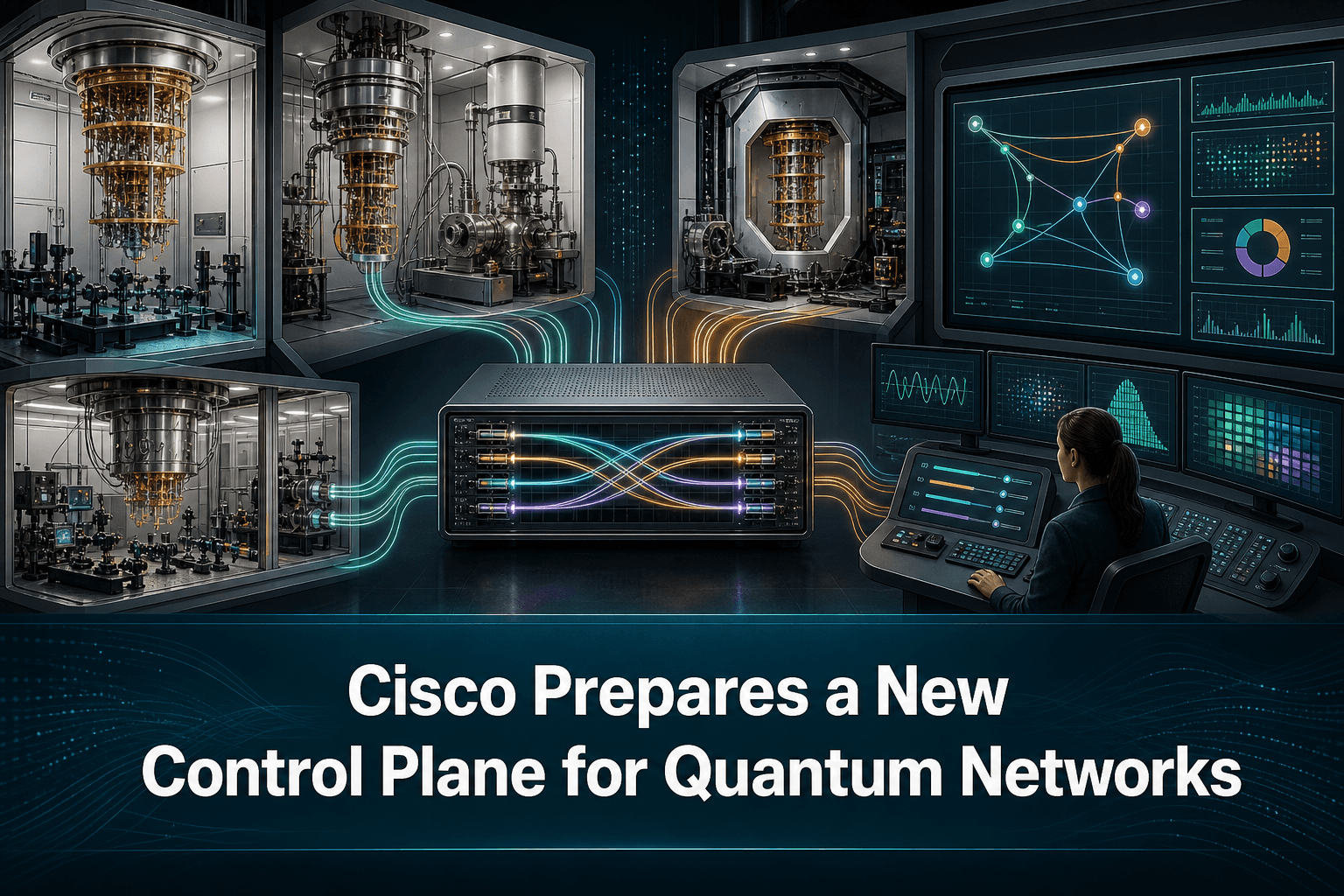
Cisco is developing a software control layer intended to make distributed quantum networks more scalable and programmable. The prototype Quantum Network Controller coordinates components including quantum computers, quantum memories, quantum switches, sources, detectors, and timing systems.
The underlying scaling problem resembles a familiar networking challenge. Point-to-point links may be manageable across a small number of nodes, but the number of required connections grows rapidly. Cisco’s Vijoy Pandey noted that connecting 1,000 quantum nodes point to point would require close to 500,000 dedicated links.
Cisco’s proposed alternative combines a shared fabric with software that decides which applications receive entanglement, at what quality, in which order, with what guarantees, and at what time.
The objective is not merely to connect more quantum devices, but to turn those connections into programmable network services.
How the Quantum Network Controller Works
The controller sits between applications and the physical quantum infrastructure. Rather than requiring an application to understand how every device produces or transports entanglement, the software presents interfaces for device categories such as:
Entanglement sources
Quantum switches
Detectors
Timing systems
A hardware abstraction layer, or HAL, sits underneath these interfaces. Cisco says this approach is intended to let hardware from different vendors connect through a consistent interface for its device category.
An application can request entanglement by specifying its operational requirements:
The communicating endpoints
The required rate
The expected fidelity
The required timing
The controller then coordinates the infrastructure needed to fulfill that request. Cisco calls this model Entanglement-as-a-Service, or EaaS: entanglement becomes a resource scheduled on demand rather than one tied to a dedicated physical connection.
A Different Observability Model
Quantum networking cannot simply reuse every classical monitoring technique. Reading the information held in a quantum state destroys that state, so the controller cannot inspect traffic in the way a conventional network-monitoring tool examines packets.
Cisco instead describes a statistical and policy-driven approach. The controller:
Verifies link quality statistically.
Applies predefined tuning when performance drifts.
Retries or reinitializes operations when required.
Escalates to a person if automated correction fails.
Continues checking link health while an application uses it.
Reclaims the associated hardware when the job ends.
This makes closed-loop control especially important. The controller is not only a provisioning system; it is designed to keep evaluating whether the requested quantum service remains healthy.
The Role of the Universal Quantum Switch
The controller uses Cisco’s previously introduced Universal Quantum Switch. According to Cisco, the switch is designed to connect quantum systems from different vendors and support major qubit-encoding technologies at room temperature over standard telecom fiber.
When two quantum computers need to communicate, Cisco says the switch accepts the arriving signal, translates it into a common language for routing, and delivers it in the format required by the receiving system without losing quantum information.
The controller and switch therefore address different parts of the problem:
The switch provides the shared connection fabric and signal-handling function.
The controller schedules resources, coordinates devices, enforces requested service characteristics, and monitors link health.
Cisco also identifies its Network-Aware Quantum Compiler prototype as another component working with the controller, reinforcing the broader goal of coordinating computation with network resources.
What Network Teams Should Track
The Quantum Network Controller remains a research prototype, so operational teams should treat it as an architectural direction rather than production-ready infrastructure. Nevertheless, it highlights several areas worth following.
1. Hardware abstraction and interoperability
A HAL can reduce the amount of device-specific knowledge exposed to applications. Teams should watch how interfaces are defined across sources, switches, detectors, memories, and timing systems—and how interoperability across vendors is validated in practice.
2. Quantum service objectives
Requests may include rate, fidelity, timing, and endpoint requirements. These parameters could become the quantum-network equivalent of service objectives, making admission control, scheduling, and resource contention key operational concerns.
3. Statistical assurance
Because direct traffic inspection is not available in the conventional sense, teams will need to understand what statistical measurements establish link health, how drift is detected, and which conditions trigger tuning, retry, reinitialization, or human escalation.
4. Closed-loop automation
Quantum operations demand precise timing and continuous coordination. The maturity of automated remediation—and the safeguards around it—will be as important as initial provisioning.
5. Dependencies on classical infrastructure
The design uses standard telecom fiber and a software controller. As the technology matures, network teams should document the conventional connectivity, compute, timing, configuration, and lifecycle dependencies surrounding experimental quantum systems.
6. The boundary between compiler and controller
The relationship between quantum applications, compilers, and the network control plane will shape responsibility for placement, scheduling, and resource selection. Teams should track where those decisions are made and which interfaces expose them operationally.
Where ConnectMyAssets Fits
ConnectMyAssets does not replace Cisco’s prototype controller or claim to manage quantum states. Its role is in maintaining control over the conventional multi-vendor infrastructure surrounding emerging environments.
As quantum networking develops, teams can use ConnectMyAssets modules to strengthen that operational foundation:
Dynamic CMDB and Topology: inventory supporting network assets and document their relationships.
Backup & History: version device configurations and provide one-click rollback for supported conventional infrastructure.
Compliance Engine: evaluate managed infrastructure against applicable NIS2, ISO 27001, PCI, CISA, and NIST requirements.
Per-Asset CVE Tracking: associate disclosed vulnerabilities with the relevant managed assets.
End-of-Life Tracking: identify lifecycle risk across supporting equipment.
Automation & ZTP: standardize repeatable changes and deployments where supported.
Credential Vault and SSH Bastion: centralize controlled administrative access without sending operational data to a cloud management platform.
Because ConnectMyAssets is vendor-agnostic and on-premises, it can provide a consistent management layer for today’s classical infrastructure while network teams evaluate how future quantum control planes will integrate with established operational practices.
Source: Network World