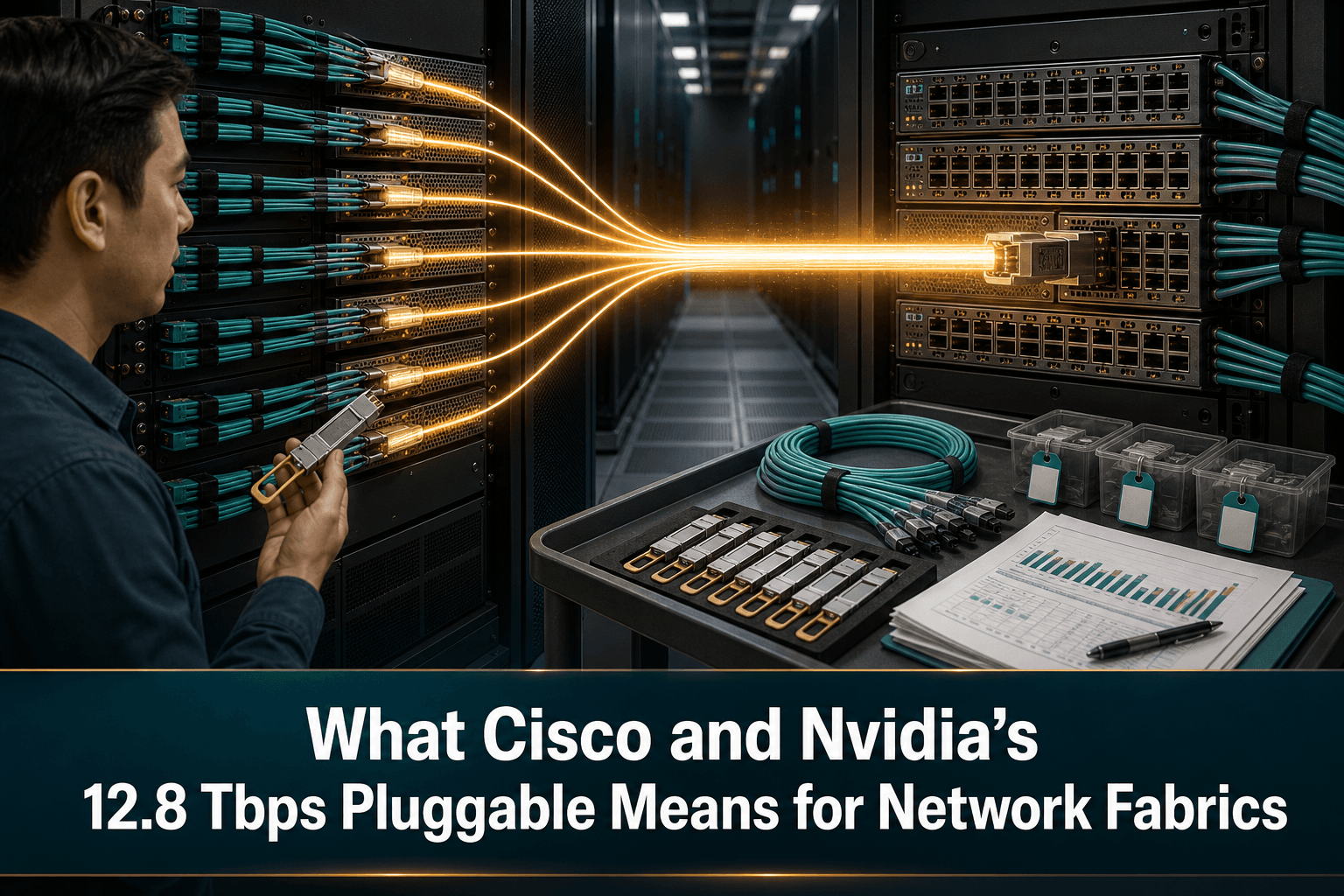
A Major Increase in Per-Pluggable Bandwidth
Cisco and Nvidia are collaborating on an optical pluggable that targets 12.8 Tbps in a single USFP module, according to The Register. Compared with the article’s 1.6 Tbps reference point, that is an eightfold increase in headline bandwidth.
The number is significant because optical pluggables are a practical boundary between switching hardware and the fiber links that form high-speed network fabrics. Increasing the capacity available through one module could affect how architects think about inter-switch connections, fabric expansion, and physical port density.
However, a target rate is not the same as deployable capacity. The reported 12.8 Tbps figure should not be interpreted as confirmation of availability, compatibility with existing equipment, or achievable application throughput. Those questions depend on the eventual platforms, network designs, and operating conditions.
What It Could Mean for High-Speed Fabrics
Higher-capacity pluggables may give network teams new options when designing or refreshing data-center fabrics. The potential effects include:
More bandwidth per physical attachment: A higher line rate can change how much aggregate capacity is possible through a given number of ports.
Different scaling choices: Architects may be able to reconsider whether growth requires more links, faster links, or a combination of both.
Greater concentration of risk: As more traffic is carried through one physical component, the operational impact of a failed link or incompatible module can increase.
New dependency checks: Switch support, fiber design, redundancy, power, cooling, and configuration all need to be assessed together rather than inferred from the optical rate alone.
The 12.8 Tbps target is therefore not just a faster replacement for a 1.6 Tbps component. It could alter the assumptions behind fabric topology and failure-domain planning. The raw rate is eight times higher, but that does not mean one module can automatically replace eight existing modules in every architecture.
Hardware Tracking Becomes More Important
A mixed infrastructure may contain several generations of switches, line cards, optics, and cabling. When a new optical format enters planning discussions, model-level inventory data becomes essential.
Teams should be able to answer:
Which devices and interfaces are installed at each site?
Which optical modules are actually deployed, rather than merely ordered or planned?
Which links are production, redundant, reserved, or unused?
Which hardware generations are approaching end of life?
Which configurations and topology relationships depend on a particular physical link?
It is also important to separate lifecycle states such as announced, under evaluation, qualified, and deployed. Recording a future 12.8 Tbps target as though it were available production capacity would distort forecasts and could lead to incorrect purchasing or migration decisions.
A Better Capacity-Planning Process
Network planners should treat the reported development as a scenario to model, not an immediate upgrade instruction.
Establish the current baseline. Record installed devices, ports, optics, link speeds, utilization assumptions, and redundancy roles.
Map physical and logical dependencies. Identify which services and network paths rely on each fabric connection.
Separate raw from usable capacity. Allow for resilience, maintenance, failures, and architectural overhead rather than planning against the headline rate alone.
Model multiple timelines. Compare continued use of current optics with gradual adoption of higher-capacity modules once they are supported and operationally validated.
Preserve configuration history. Fabric migrations often involve coordinated changes across several devices; rollback evidence is as important as the intended end state.
Review lifecycle exposure. A faster optic does not by itself resolve aging switches, unsupported software, or other end-of-life dependencies.
This approach keeps capacity forecasts tied to the real infrastructure while leaving room for emerging technology.
Where ConnectMyAssets Fits
ConnectMyAssets provides an on-prem, vendor-agnostic foundation for managing the operational data needed around this type of hardware transition.
The Dynamic CMDB keeps network assets and their relationships in a consolidated inventory, helping teams distinguish current hardware from planned additions.
Topology provides context for where high-capacity links sit within the wider fabric and which connections may become critical concentration points.
Backup & History preserves device configuration versions and supports one-click rollback when validated changes do not behave as expected.
End-of-Life Tracking helps planners avoid evaluating new optics in isolation from the lifecycle status of the switches and other infrastructure around them.
Automation & ZTP can support controlled, repeatable configuration work once compatible designs and deployment procedures have been approved.
The Compliance Engine can retain operational evidence and check infrastructure against policies aligned with frameworks such as NIS2, ISO 27001, PCI, CISA, and NIST.
The practical objective is not to mark 12.8 Tbps as available before it is deployable. It is to maintain an accurate baseline, model the possible transition, and ensure that future upgrades can be introduced with traceable configuration and lifecycle controls.
Planning for Speed Without Losing Control
Cisco and Nvidia’s reported 12.8 Tbps USFP target points toward substantially denser optical connectivity. For network teams, the immediate action is not necessarily to redesign the fabric, but to improve the quality of the records on which future decisions will depend.
Accurate inventories, topology awareness, lifecycle tracking, configuration history, and realistic capacity models will determine whether higher-speed optics become a controlled upgrade or another source of infrastructure uncertainty.
Source: The Register