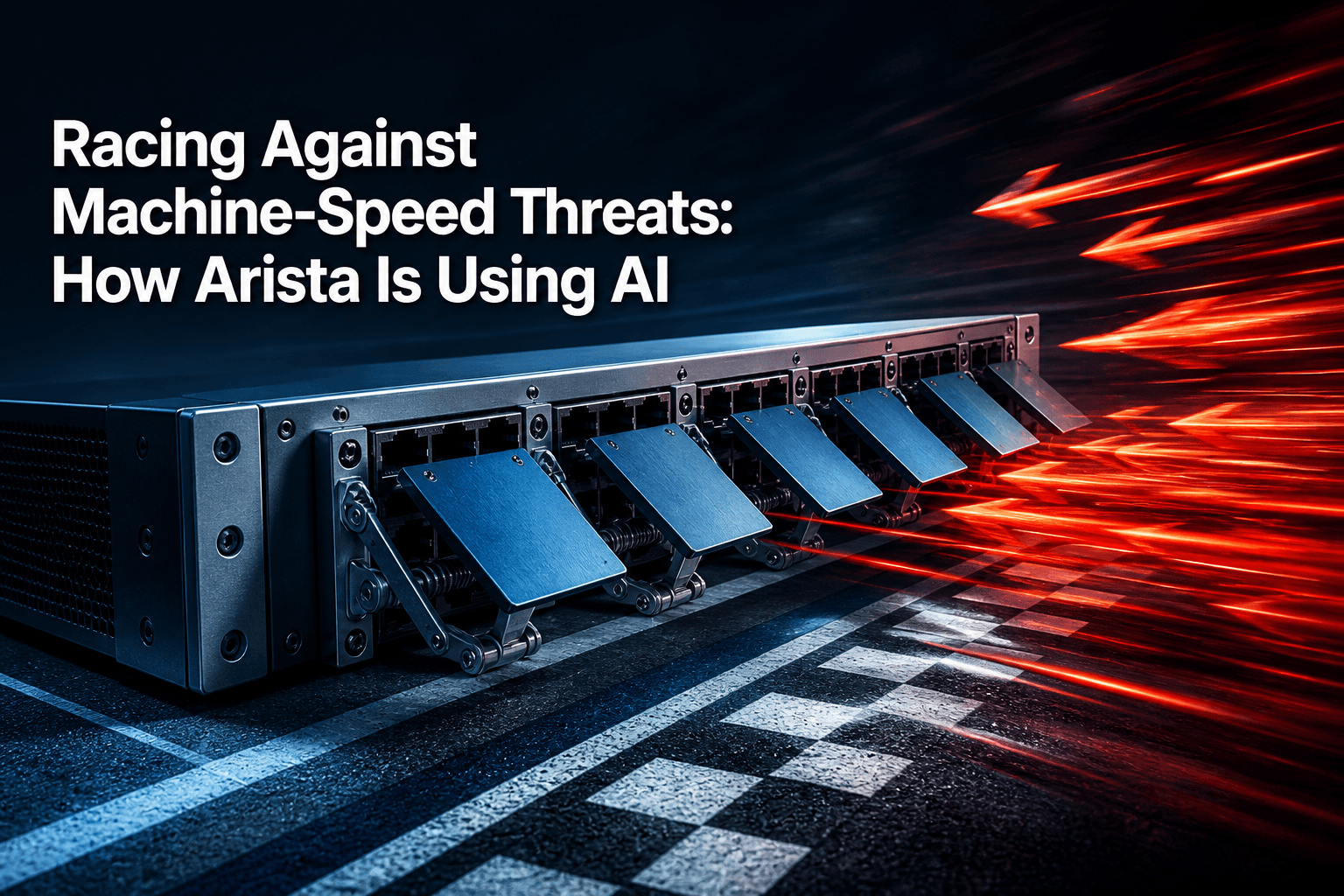
Arista is framing quality and product security as inseparable foundations of dependable networking. With the threat landscape changing faster than at any previous point in its history, the company is applying AI to help defend network products and operations against machine-speed threats.
Security at Machine Speed
The central challenge is the widening gap between the speed of automated threats and the time required for people to investigate and respond manually. AI can help security and infrastructure teams operate at a pace better matched to rapidly evolving activity, while human oversight remains essential for policy, risk and operational decisions.
Product Security as a First Principle
Arista describes product security as part of its long-standing focus on quality, not an additional layer applied after products are built. That position matters for network infrastructure because switches and related systems form part of the operational foundation on which applications, users and security controls depend.
The company also signals that customers should expect further information about its response in the weeks and months ahead. For network teams, this makes vendor security developments worth tracking alongside vulnerabilities, software lifecycle status and configuration changes.
Practical Implications for Infrastructure Teams
Machine-speed defense does not remove the need for disciplined network operations. It increases the importance of maintaining the context needed to assess and act on security findings safely.
Keep an accurate inventory of network devices, models and software versions.
Track vulnerabilities against the assets that are actually deployed.
Preserve configuration history so unexpected changes can be identified and reversed.
Validate configurations against internal and regulatory requirements.
Use controlled automation to apply approved changes consistently across infrastructure.
Monitor end-of-life and end-of-support status as part of security planning.
Where ConnectMyAssets Fits
ConnectMyAssets provides an on-prem operational layer for managing Arista and other supported network infrastructure without sending network data to a cloud service. Its hardened OVA keeps asset, configuration, credential and compliance data within the organization’s environment.
Dynamic CMDB automatically discovers managed assets and builds LLDP-based topology context.
CVE Tracking associates known vulnerabilities with individual network assets.
Backup & History records configuration versions with SHA256 verification and supports one-click rollback.
Compliance Engine evaluates configurations against frameworks including NIS2, ISO 27001, PCI-DSS, CISA and NIST.
End-of-Life and End-of-Support tracking helps teams identify lifecycle-related exposure.
Automation & ZTP supports controlled mass deployment and zero-touch provisioning.
AI Insights runs locally, keeping operational analysis on-prem.
These capabilities complement vendor-level security innovation by giving infrastructure teams the inventory, configuration history, compliance evidence and automation controls needed to turn security information into managed action.
Source: Arista