From Assisted Triage to Autonomous Action
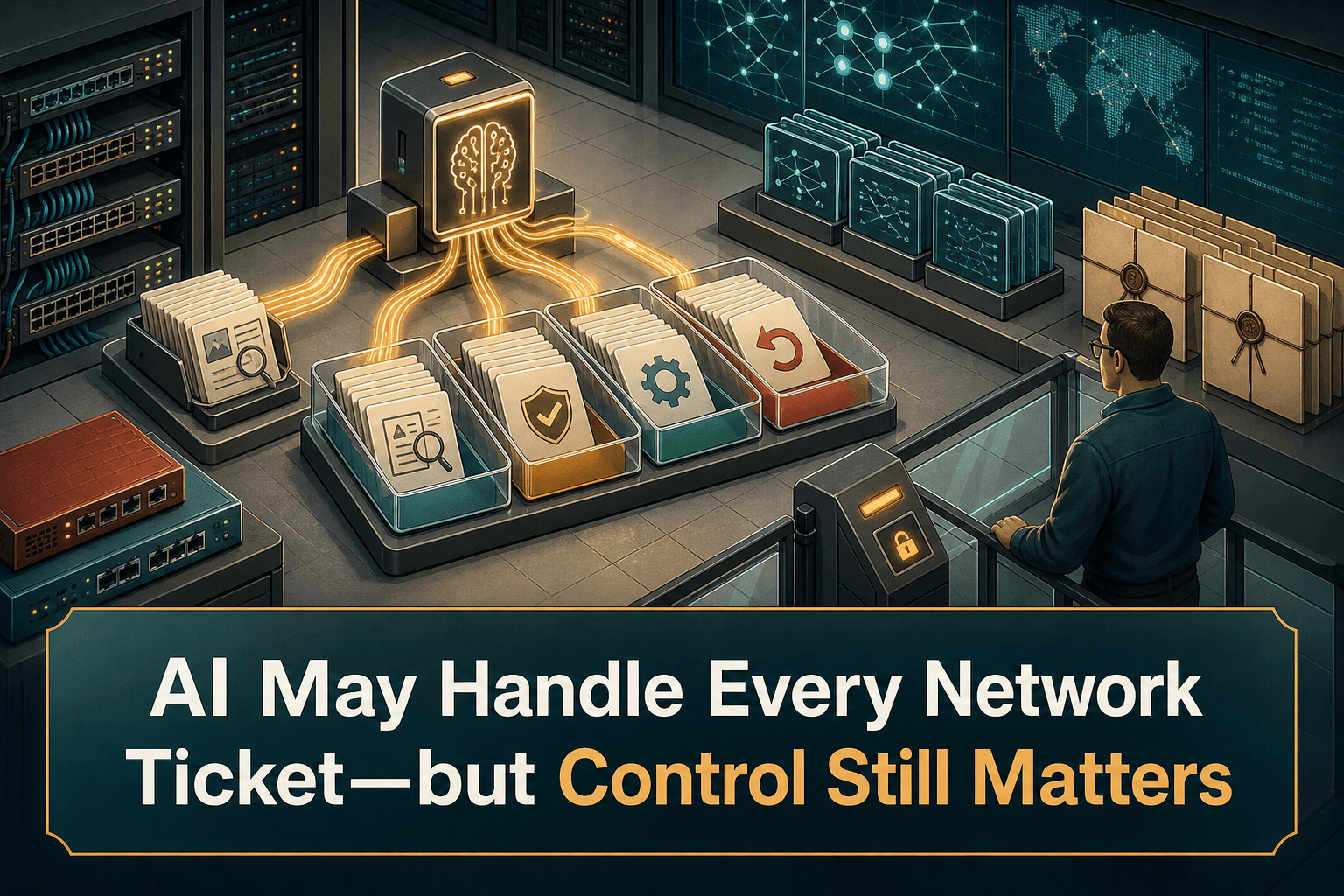
HPE’s networking boss predicts that AI will handle all trouble tickets without humans within two years, according to The Register. The argument is that operators may eventually trust agents much as drivers now trust automatic transmissions: the underlying decisions happen with little direct intervention.
That is a striking forecast, but a trouble ticket is more than a diagnosis. In network operations, closing a ticket can involve gathering device state, interpreting policy, changing a configuration, validating service, recording evidence, and reversing the change if the outcome is wrong.
The key question is therefore not simply whether an AI agent can act. It is whether the organization can prove what it observed, why an action was allowed, what changed, and whether the result was verified.
What Trustworthy Ticket Automation Requires
Evidence Before Execution
An agent should work from a known operational state rather than an incomplete ticket description. Useful evidence can include the affected asset, current configuration, previous versions, topology context, known vulnerabilities, and lifecycle status.
That context must also be retained. If an automated decision is reviewed later, the team needs the evidence that was available when the decision was made—not merely the current state of the network.
Explicit Approval Boundaries
“Without humans” does not have to mean “without governance.” Different actions carry different levels of risk:
Read-only diagnostics may be safe to run automatically.
Standard, pre-approved remediation can follow a defined workflow.
High-impact changes may still require authorization.
Actions outside policy should be blocked or escalated.
The authorization model should be based on the asset, action, environment, and potential blast radius rather than on an agent’s confidence alone.
Complete Change History
Every automated change should create an accountable record. At minimum, operators need to know:
Which asset and ticket were involved.
What state the agent examined.
Which action it selected.
Whether an approval was required and granted.
What configuration changed.
How the result was validated.
Whether rollback was needed.
Without this chain, rapid automation can turn troubleshooting into forensic reconstruction.
Rollback as Part of the Workflow
A successful command is not necessarily a successful remediation. An agent needs post-change checks tied to the original fault. If validation fails, the workflow should stop, escalate, or restore the previous known-good configuration according to policy.
Rollback should therefore be designed into ticket automation rather than treated as an emergency feature.
A Practical Adoption Path
Network teams do not need to jump directly from manual tickets to full autonomy. A staged model makes the operational risk visible:
Observe: AI collects context and proposes likely causes without making changes.
Recommend: The agent prepares a remediation plan for human review.
Execute with approval: Approved actions run automatically, with evidence and configuration capture.
Automate known cases: Repetitive, bounded incidents follow pre-approved workflows.
Expand conditionally: Autonomy grows only where validation, rollback, and audit records have proved reliable.
This progression allows trust to be earned from operational results rather than from a broad promise of intelligence.
How ConnectMyAssets Helps
ConnectMyAssets provides an on-prem foundation for controlled network automation across multi-vendor infrastructure. Its modules can support the evidence and guardrails surrounding AI-driven ticket handling:
Dynamic CMDB and Topology provide asset and relationship context before an action is selected.
Backup & History preserves configuration versions and supports one-click rollback when remediation does not produce the expected outcome.
Automation & ZTP enables repeatable workflows instead of unrestricted, improvised device changes.
Compliance Engine helps assess changes against frameworks and internal requirements while retaining compliance evidence.
Per-asset CVE Tracking and End-of-Life Tracking add vulnerability and lifecycle context to prioritization decisions.
Credential Vault and SSH Bastion help keep privileged access within controlled operational paths.
Local AI Insights keeps AI-assisted analysis on premises, aligned with environments where network data cannot be sent to external services.
ConnectMyAssets does not make governance optional. It gives operators the configuration records, asset context, controlled execution paths, and recovery capabilities needed to place automation inside an auditable operating model.
Autonomy Is a Control-System Question
The prediction that AI will handle every trouble ticket focuses attention on technical capability. For infrastructure teams, the more durable issue is control.
An agent can be fast and still be unsafe. It becomes operationally useful when its access is bounded, its evidence is preserved, its changes are attributable, and its decisions can be reversed. That is how automated ticket handling can progress from an impressive demonstration to dependable network operations.
Source: The Register